On this page
Where a flexible tap connector can leak
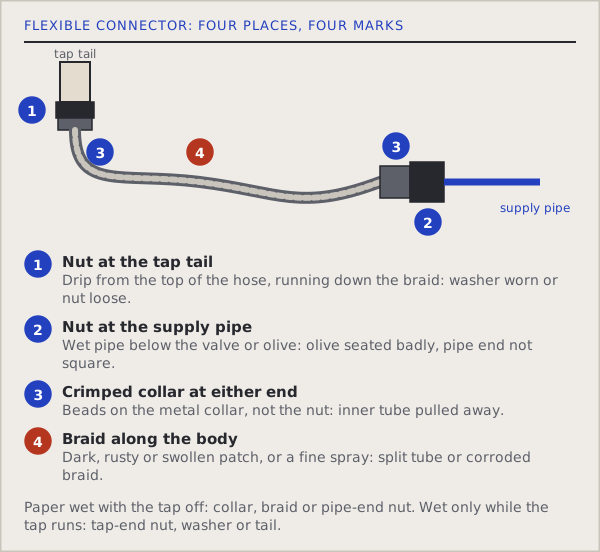
A flexible tap connector is a short braided hose with a nut at each end. One nut screws onto the tail of the tap, with a washer inside. The other nut clamps onto the copper supply pipe, usually through a compression olive, often with an isolation valve in between. The braid is only a cover. The watertight part is the rubber tube inside it, which is held to each end fitting by a crimped collar.
That gives four places to look, and each one tells a different story.
| Place | What you see | What it usually means |
|---|---|---|
| Nut at the tap tail | Drips from the top of the hose, running down the braid | Washer worn, flattened or missing; nut loose; tap tail damaged |
| Nut at the supply pipe | Wet pipe below the valve or olive, drip from the nut | Olive seated badly, pipe end not cut square, or the joint moved |
| Crimped collar at either end | Beads of water on the metal collar, not the nut | The rubber inner tube has pulled away from the end fitting |
| Braid along the body | Dark, rusty or swollen patch, or a fine spray under pressure | The inner tube has split or the braid has corroded |
A dry-paper check you can do safely
Dry the hoses and the cupboard floor with a cloth, then wrap a strip of kitchen roll loosely round each end and under the middle of each hose. Leave the tap off for ten minutes and look. Then run the tap for a minute, turn it off, and look again. Do not twist, pull or tighten anything while you do this.
- Paper wet with the tap off: the leak is under mains or tank pressure and is coming from the collar, the braid or the pipe-end nut
- Paper wet only while the tap runs: the tap-end nut, the washer or the tap tail
- Paper dry but the cupboard floor is still wet: the water is arriving from somewhere else, such as the tap base, the waste or the isolation valve
- A damp patch that is warm to the touch: the hot hose, not the cold
If water is running near electrics or a hose is spraying, turn off the water at the stop tap and keep clear of wet sockets.
Why age and installation matter more than the brand
Nobody can read a safe age off a hose. There is no figure fixed in the water regulations, and manufacturers give their own advice, so the honest approach is to treat a hose of unknown age as a hose to look at, not a hose to forget. The Water Supply (Water Fittings) Regulations 1999 do require every water fitting to be watertight and adequately supported (Schedule 2, paragraph 4), which is a standard a worn hose stops meeting long before it fails visibly.
Installation damage is the more common story. One retailer installation sheet for flexible connectors lists what a hose should not be: twisted, squashed, stretched, kinked or bent at sharp angles, especially near the ends. A hose squeezed round a corner behind a deep drawer, or twisted when the tap was fitted, is under strain at the collar every time the tap is opened. Connections made or disturbed during a refit are the usual suspects, and connection checks by appliance after a kitchen is fitted lists what to look at.
The same sheet tells the fitter not to over-tighten the nuts. A nut forced past the point where the washer seals can crush the washer or distort the tap tail, and the joint that was tightened hardest is often the one that weeps.
An age check is therefore a set of questions. Was the kitchen fitted before you moved in, and do you know when? Is the hose chrome-plated braid with rust spots, or white crust at the collars? Does it move when the tap is moved? Any yes is a reason to have the hose looked at, even when nothing is wet.
When the connector is not the problem
The hoses are the commonest suspect under a sink because they are the easiest joints to see. They are not the only ones. A kitchen tap leaking at the base sends water down the outside of the tap tail and onto the hoses, so the hose looks wet but the source is above it. A leak under the kitchen sink can equally be the waste, as covered in sink waste leaking behind the cupboard, and a slow drip from an isolation valve runs down the pipe and drips off the nearest hose. A boiling water tap has a tank under the sink with hoses of its own, covered in boiling water tap leaking.
Water also travels. A wet back panel or a swollen plinth can be several joints away from the hose that started it, which is why a wet cupboard needs the dry-paper check before a part is changed. A worktop that has swollen beside the sink is read in kitchen worktop swelling near the sink.
When the source cannot be seen
If the paper test points at the connector but the nut sits behind a boxed-in worktop, or the paper stays dry while the cupboard does not, the leak is inside something. Moisture mapping shows where the wet area is centred, an endoscope can look behind a back panel through a small opening, and a pressure test on the cold and hot branches shows which pipe is losing water. These are the methods described under kitchen leak detection. For a leak inside one property the locate visit is the fixed price package, and damage to walls, ceilings and finishes is quoted by a partner team of builders and decorators, who give a price for each job. Leak damage repair and remediation covers the finishes.
Sources
The Water Supply (Water Fittings) Regulations 1999, Schedule 2, paragraph 4, read on legislation.gov.uk in October 2026.
Installation sheet for flexible tap connectors supplied by a UK home-improvement retailer (reference C6041), read in October 2026. It gives installation cautions only and no replacement interval.
Questions customers ask
How often should a flexible tap connector be replaced?
There is no interval set in the regulations, and manufacturers differ, so follow the data sheet for your hose. If you do not know the age, check it for rust, white crust at the collars and kinks, and treat an unknown age as a reason to look.
Can a flexible tap connector leak without dripping?
Yes. A fine seep at the collar can evaporate or soak into the cupboard base before it forms a drip, and a split inside the braid can show only as a damp, stained patch beneath the hose.
Is a leaking tap connector an emergency?
It can be. A hose that sprays or runs continuously needs the water turned off at the stop tap. A slow weep is not an emergency, but it can soak a chipboard cupboard base and the floor below it over weeks.
Why is the cupboard wet when the hoses are dry?
Water from the tap base, the waste, the isolation valve or a joint behind the back panel can all land in the cupboard while the hoses stay dry. Run the dry-paper check with the tap off, then with it running, and see which strip wets first. That separates a supply leak from a waste leak.
What does it cost to find a leak behind a kitchen worktop?
A leak inside one property is located for the £580 package, with the total known before the visit. Work that runs longer is charged at £180 an hour, a fixed hourly rate that cannot rise on the day. No VAT is charged. Repairs, opening the worktop and making good are separate.