Acoustic Leak Detection: How a Leak Sounds Through Copper, Plastic and Concrete
Acoustic leak detection uses sensitive sensors to listen for the sound of water escaping a pressurised pipe. Sound carries well along metal pipe and badly along plastic, and a pipe with no pressure makes none. It is charged at £180 an hour as part of a survey. No VAT is charged.
What the visit covers
- Listening at accessible points on the pipework with contact sensors
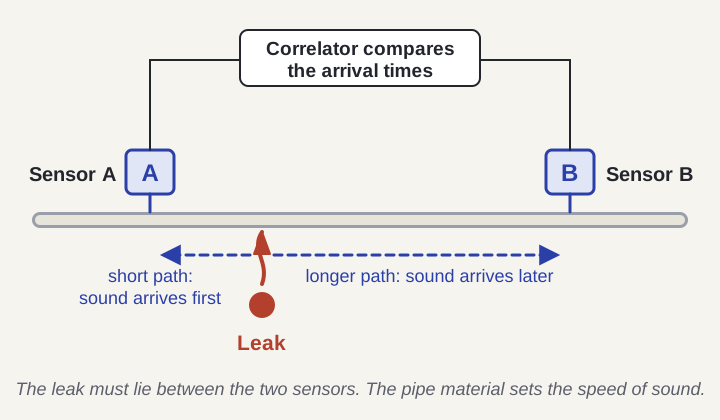
- Comparing the sound at two points to place a leak between them
- Listening at the surface above a suspected run to confirm a position
- A written report of what was heard, where, and what it could not tell
Published prices
What it costs
- Fixed-price leak location package
- The package gives one fixed price, known before the visit, to locate a leak in one property using whichever methods the leak needs.
- £580Fixed price
Or by the hour
- Standard leak detection
- General water leak detection in a property.
- £180an hour
No VAT is charged
A fixed hourly rate that cannot rise on the day
No find, no fee applies when a live leak inside your own property cannot be located. No find, no fee in full
Order of work
Pressurise and quieten
The supply has to be under pressure for a leak to make noise. Taps, appliances and cisterns are stopped so that the only moving water is the leak.
Listen at two points
Sensors sit on valves, fittings or exposed pipe either side of the run in question, and the sound at each is recorded.
Place the sound
The difference in when the sound reaches each sensor, and its strength, places the source between them. A surface sensor then narrows it down.
Confirm another way
Because sound can mislead, a position is confirmed with a pressure test, tracer gas or a small opening before anyone commits to an opening up.
How a leak sounds, and how far the sound goes
Water forced through a small hole makes noise, and the pipe carries that noise along its length. The pipe wall, the water inside it and the ground or floor around it all affect how far it goes. Metal pipe carries it a long way. Plastic damps it hard, and the sound that survives is low in pitch.
Research carried out by the Institute for Research in Construction in Canada, with funding from the National Research Council and the AWWA Research Foundation, put five professional leak detection teams to blind tests on simulated leaks in plastic water pipe. The article reporting the work, published in June 2000, found that leak noise in plastic pipe is dominated by low frequencies and that correlators, in automatic mode or set by operators, often looked at too high a frequency range and missed the leak. The researchers concluded that acoustic methods can find leaks in plastic pipe, but only with settings and sensors suited to that pipe.
Inside a home the same sound is often what you hear first: a hissing sound in the wall is worth reporting, and so is a leak on plastic water pipe, which is the hardest case to hear. The method is sensitive, and it is fussy. A concrete floor or slab does not stop sound, but it changes how much of it reaches the surface.
Does not work when: the pipe has no pressure, the leak is too small to make a sound, the only accessible points are far apart on plastic pipe, or the building is noisy from traffic, pumps or running water.
How the method is described here
This page describes the method and does not present one of our jobs as an acoustic job. The method is part of the kit and is used when the pipe suits it. The case records on this site that mention acoustic work do so only as a recommendation, and the N10 record is one: it advises acoustic testing where a thick concrete floor limits other methods, and says plainly that it was not carried out on that visit.
For a longer explanation see how acoustic leak detection works, and for the pipe-material question see acoustic detection on plastic pipe.
What acoustic detection costs
Acoustic work is charged by the hour as part of a survey: £180 an hour. No VAT is charged, and the rate is a fixed hourly rate that cannot rise on the day.
For a leak inside one property, the £580 package for locating a leak keeps acoustic listening and any back-up method under one price. The acoustic detection cost guide compares the two routes.
If the leak may become an insurance claim, the written report is what the insurer assesses. Cover depends on the policy and the insurer decides; see insurance-covered leak detection.
If the leak cannot be located
No find, no fee applies when a live leak inside your own property cannot be located. The no find, no fee terms set out the boundary in full. A leak that belongs to a neighbour, a communal pipe or the water company main is a located leak and is charged. A visit that shows no leak exists is also charged.
Sources and dates
The statements about plastic pipe, low frequencies and correlator settings come from the Plumbing and Mechanical magazine article on the Institute for Research in Construction study, published June 2000 and read October 2026. Statements about our own records come from the case page cited.
Questions customers ask
Does acoustic detection work on plastic pipe?
It can, but plastic damps sound and the leak noise is low in pitch, so the equipment has to be set for it. A published study found that settings too high in frequency often missed the leak.
Can it find a very slow drip?
Often not, because a drip may be too quiet to hear against background noise. Pressure testing or tracer gas is used instead.
Does it need the water on?
Yes. A pipe with no pressure makes no leak noise, so the supply has to be on and everything else turned off.
How is it charged?
As part of a survey at £180 an hour. No VAT is charged. Or £580 as the package for one property.