Non-Invasive Leak Detection: What Happens Before Anyone Lifts a Floor
Non-invasive leak detection finds a hidden leak by measuring from the surface: pressure, sound, gas, temperature and moisture. Nothing is opened until the position is marked. Opening up becomes unavoidable only when the pipe has to be reached to do anything about the leak. It is charged at £180 an hour. No VAT is charged.
What the visit covers
- Reading the history of the leak and the layout of the pipework before any tool is used
- Isolation and pressure tests to establish which pipe is losing water
- Surface methods to place the loss: acoustic, tracer gas, thermal imaging and moisture readings
- An endoscope through the smallest opening that will show the pipe, if the surface methods leave doubt
- A written report of what was found and where, with the steps in the order they were taken
Published prices
What it costs
- Fixed-price leak location package
- The package gives one fixed price, known before the visit, to locate a leak in one property using whichever methods the leak needs.
- £580Fixed price
Or by the hour
- Standard leak detection
- General water leak detection in a property.
- £180an hour
No VAT is charged
A fixed hourly rate that cannot rise on the day
No find, no fee applies when a live leak inside your own property cannot be located. No find, no fee in full
Order of work
Listen and look
Where the damp is, when it started, what is above and below it, and whether the stop tap is reachable. Where to find the stop tap is the first thing worth knowing before anyone arrives.
Isolate and pressure test
The cold, hot and heating circuits are separated and tested one at a time, so the search starts with the one that is losing water. See isolation testing step by step.
Locate from the surface
Acoustic sensors, tracer gas, a thermal camera or a moisture meter place the loss on the floor plan, in whichever order suits the pipe and the floor.
Look, then open
A camera on a lead goes through the smallest opening that shows the pipe. Only if that is still not enough does a larger opening follow, and the report says which step ended the search. Clearing the access beforehand helps, as preparing for a leak detection visit lists.
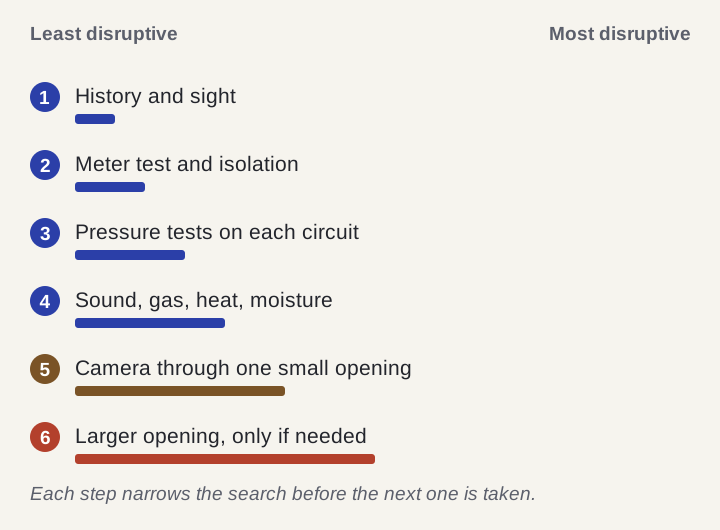
The ladder, from least to most disruptive
Every step below is taken from the surface, or from an existing access point such as a boiler cupboard, a bath panel or a loft hatch. Each one either narrows the search or removes a pipe from it.
- Step one, history and sight: stains, smells, meter movement, appliances, recent work, and the age and material of the pipes.
- Step two, the meter test and isolation: closing taps and appliances and watching whether a meter still turns, then closing sections of pipe to find which one is losing.
- Step three, pressure tests on the cold, hot and heating circuits: a loss on one and not the others cuts the search.
- Step four, surface location: sound, gas, thermal images and moisture readings, used alone or together.
- Step five, a camera through an existing access point or one small opening.
- Step six, a larger opening, only where the pipe has to be reached.
The one line where opening up becomes unavoidable
Surface methods say where. They cannot mend a joint. If the leak is under a floor or inside a wall, someone has to reach the pipe to deal with it, and that needs an opening. What non-invasive work changes is the size of that opening and whether it is in the right place.
A case on record shows the effect. On a shower waste leak into a flat in CR8, one small opening in a ceiling and a camera on a lead showed the cause with the shower running, which made a larger opening unnecessary for diagnosis. The trace and access survey page covers that step on its own, and the opening and making good are separate from the detection, as leak damage repair and remediation explains.
What non-invasive detection cannot do
It cannot see through a floor, so everything depends on the signal reaching the surface. A thick slab, a sealed floor finish or a pipe that cannot be isolated weakens the signal. A leak that only opens under certain conditions, such as a hot tap running or a shower in use, may not show on a cold, quiet visit. A leak that is not plumbing at all, such as water entering through brickwork, shows as damp with no failing pipe, and the right answer then is that the pipes are clear. How firmly a position can be stated is covered in how accurate leak detection is, and a wet room that leaks shows why damp can appear far from the cause.
The methods comparison puts the five techniques side by side, a phone thermal camera is compared with a survey camera on its own page, and how professionals find a leak sets the order out as a decision chart.
What it costs
The survey is charged at £180 an hour. No VAT is charged, and the rate is a fixed hourly rate that cannot rise on the day. Inside one property, the same survey can be bought as the £580 package for one property.
No find, no fee applies when a live leak inside your own property cannot be located. A leak that belongs to a neighbour, a communal pipe or the water company main is a located leak and is charged. Ruling a leak out is also charged.
Where a claim is involved, the written report is the record an insurer assesses. Cover depends on the policy and the insurer decides; see insurance-covered leak detection.
Sources and dates
The location of the stop tap, inside the home where the supply enters or outside near the boundary under a cover, is from GOV.UK guidance on protecting a property from flooding, read October 2026. The case record cited is our own.
Questions customers ask
Will you have to dig up my floor?
Not to find the leak. Detection is done from the surface and from existing access points. An opening is needed only afterwards, to reach the pipe, and it is placed where the readings point.
Is non-invasive detection always possible?
No. A thick slab, a sealed floor or a pipe that cannot be isolated can defeat the surface methods. The report then says how far the search got and what the next step would be.
Which methods are used?
Whichever the leak needs, in order: isolation and pressure tests, then acoustic, tracer gas, thermal imaging or moisture readings, then a camera through a small opening.
How is it charged?
At £180 an hour, or as the £580 fixed-price package for one property. No VAT is charged.