On this page
What does a thermal camera actually measure?
Every surface gives off infrared radiation, and the camera turns the amount it receives into a temperature for each pixel. What it reports is the temperature of the outer face of whatever it is pointed at: paint, plaster, tile, the underside of a floor. It cannot look through a wall, and it cannot see a pipe that is hidden unless that pipe changes the temperature of the surface in front of it.
This is the first thing to understand about the method. A wet wall and a cold wall can look the same on screen. The camera shows a difference in temperature, and the person using it has to work out whether water is a likely reason for that difference.
Why does a leak change a surface temperature?
There are two ordinary ways. The first is cooling. Water in a porous material such as plaster or screed evaporates from the surface, and evaporation takes heat with it, so a damp patch often reads cooler than the dry material around it. A cool patch on a ceiling below a bathroom is the usual example.
The second is warming. A leaking hot supply, or a leaking heating pipe, delivers heat into whatever is around it. On a floor that is meant to be at room temperature, a warm stripe that follows a pipe route is a reason to suspect that pipe. This is also how a heating leak under a floor can be followed as a trace on the surface without opening anything.
Neither effect is guaranteed. A thick layer of screed or insulation spreads and delays the signal, and a leak that has stopped leaves a wet but evenly cool area with no edge to read. The limits of thermal imaging in screed and insulation covers those cases one at a time.
What the picture shows and what it can mean
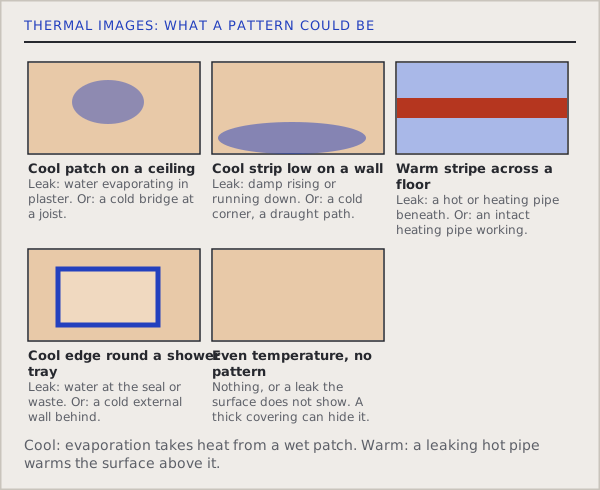
A thermal image is a map of differences, and each difference has more than one possible cause. This table sets out the common ones for a home. The right-hand column is why the image is never the finding on its own.
| What the image shows | A leak could explain it | Something else could explain it |
|---|---|---|
| Cool patch on a ceiling | Water in the plaster, evaporating | A cold bridge at a joist, or an uninsulated section |
| Cool strip low on a wall | Damp rising or running down from above | A cold external corner, or a draught path |
| Warm stripe across a floor | A leaking hot or heating pipe beneath | An intact heating pipe or underfloor loop that is simply working |
| Cool edge round a shower tray | Water at the seal or the waste | A cold external wall behind the tray |
| Even temperature, no pattern | Nothing, or a leak the surface does not show | A thick covering that hides the pattern |
How a survey uses the camera in practice
The camera is used first because it is quick and touches nothing. The team scans the walls, ceilings and floors around the suspected area and notes where the temperature pattern does not fit what the building should look like. That narrows a whole room to a few places to examine.
Then a different instrument checks each place. A moisture meter, for example, can say whether the material is wet, which the camera cannot. A pressure test says whether a supply is losing water. Tracer gas or an endoscope can then put the position beyond doubt. Why one method is never enough explains why a survey is built this way.
The job records show the camera doing exactly this and no more. On a flat in SW3 with black staining on a bedroom wall, a thermal imager was aimed at the shower enclosure and tray, but the record treats a cool patch as a reason to check with the meter, never as a finding. The pressure tests on the hot and cold supplies were clear, and the survey ruled the pipes out.
What the camera needs to give a clear result
Three things make a thermal image readable. The first is a temperature difference between the inside and the outside of the building. Designing Buildings, which summarises thermography guidance for traditional buildings, gives at least 5 degrees Celsius as a minimum between indoors and outdoors, and more commonly 10 degrees, for building surveys. A mild day gives a flatter picture than a cold one.
The second is the surface itself. Only materials with a high emissivity, such as brick and plaster, give a dependable reading. Metals and glass have low emissivity and tend to reflect the temperature of whatever is around them, so a chrome pipe or a window shows the room it is reflecting, not its own temperature. Reading a thermal image and its colour scale goes through this in detail.
The third is the operator. Camera quality and resolution matter (can a phone thermal camera find a leak shows how far a cheap one goes), and so does knowing the building: a cold area can reflect the design as easily as a fault. A British Standard published in 2023 covers infrared detection of heat, air and moisture irregularities in buildings, including the equipment, the operator and how results are reported.
What it cannot tell you
It cannot tell you that a pipe is leaking, only that a surface is warmer or cooler than expected. It cannot see through plaster, a bath panel or a floor covering. It cannot give a depth. It cannot separate a leak from condensation, rain penetration or a missing patch of insulation without further evidence. Condensation is the usual one: a surface colder than the room's dew point collects water and reads cool, and a damp chimney breast is a common case where rain or flue condensation gives a pattern a pipe leak could also make.
Because of that, a report built on a thermal image alone should read as "a temperature pattern consistent with moisture here, to be confirmed" and never as "a leak is here". If you are given a pinpoint from a thermal photograph by itself, ask what second method confirmed it.
What it costs
Thermal imaging is one of the methods used within a visit, not a separate product, and the thermal imaging leak survey page describes it. On hourly work it is charged at the standard rate of £180 an hour. No VAT is charged. A fixed hourly rate that cannot rise on the day. Thermal imaging survey cost covers when it pays and when it does not.
The £580 fixed price package is known before the visit and uses whichever methods the leak needs, the camera among them. No find, no fee applies when a live leak inside your own property cannot be located.
Sources and dates
The 5 and 10 degree temperature differences, and the emissivity and reflection limits, are from the Designing Buildings article on thermography for traditional buildings. The point that reflective surfaces are poor emitters, and that readings on bare metal are inaccurate, is from the Fluke guide to reflectivity in thermography. The 2023 British Standard on infrared detection in buildings is from the British Standards Institution catalogue entry. All read in October 2026. The SW3 case is from the job records behind this site. The cooling-by-evaporation and warm-pipe explanations are our own plain-language summary of how the method behaves.
Questions customers ask
Can a thermal camera see a leak inside a wall?
Not directly. A thermal camera shows the temperature of the wall surface and cannot look through plaster. If a leak cools or warms that surface enough to make a pattern, the pattern points to the area to examine, and a moisture meter, a pressure test or tracer gas then confirms whether water is there.
Does a cool patch always mean a leak?
No. A cold bridge at a joist, a draught path, a cold external corner or a thin patch of insulation can look just as cool as a wet patch. The image shows a difference in temperature, and the person using it has to work out whether water is a likely reason. That is why a moisture meter or a pressure test follows.
Is thermal imaging safe for my property?
Yes. The camera only receives infrared radiation that surfaces already give off. It does not send anything into the building, nothing is opened or lifted to use it, and it touches nothing, which is why it is used first on a visit. It suits period buildings for the same reason.
Does thermal imaging work in summer?
It can, but a small difference between inside and outside temperature gives a flatter image. Designing Buildings gives at least 5 degrees Celsius as a minimum, more commonly 10, for building surveys. Cooler weather usually gives more contrast, as the thermal survey in cold weather note explains.