On this page
Why does paint bubble on a wall?
A paint film is a thin skin. Anything that collects underneath it, whether liquid water, vapour working outwards from a damp wall, or salts drawn to the surface as water evaporates, lifts the skin where its grip is weakest. The bubble is the symptom. It says moisture is present behind the paint, and nothing more specific than that.
GOV.UK guidance on damp and mould in the home lists four routes for moisture: condensation, penetrating damp from outside, rising damp from the ground, and leaks from pipes, overflowing baths or sinks. It adds that the causes can overlap. That overlap is why the look of the bubble matters. It is the first clue to which route you are dealing with.
What do the size, height and feel of the bubbles mean?
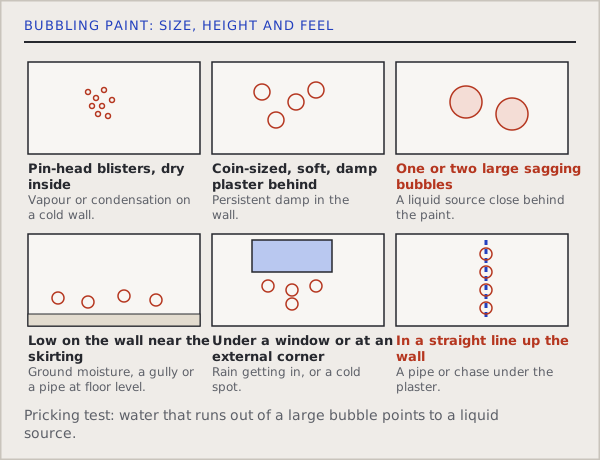
Read the bubbles before you touch them. Where they sit on the wall, how big they are and what is inside them separate most cases. The table is a field guide, not a diagnosis, and two rows can be true at once.
| What you see | Most likely moisture route | What would support it |
|---|---|---|
| Pin-head blisters in a cluster, dry inside | Vapour or condensation on a cold wall | Worse in cold weather, the room is humid, the patch is on an outside wall |
| Coin-sized soft bubbles with damp plaster behind | Persistent damp in the wall | The patch stays after heating and ventilation and feels cold and slightly clammy |
| One or two large sagging bubbles that hold water | A liquid source close behind the paint | Water runs out when pricked, and the patch grows after a bath or shower |
| Bubbles low on the wall near the skirting | Ground moisture, a gully or a pipe at floor level | A tide-mark above the skirting, white salts, wetter after rain |
| Bubbles under a window or beside an external corner | Rain getting in, or condensation at a cold spot | Worse after driving rain, dry in a dry spell |
| Bubbles in a straight line up or across the wall | A pipe or a chase under the plaster | The line follows a radiator pipe, a tap drop or a cable run |
Five questions that narrow it down in ten minutes
Answer these in order, and write the answers down with the date. The notes are useful to anyone who looks at the wall later, because moisture behaves differently from week to week.
- Is the wall an outside wall or an inside one? An outside wall is cold in winter, so condensation and rain are both possible. An inside wall that is bubbling is harder to explain with weather and is worth taking seriously.
- Is the patch at the same height as a bath, basin, shower, sink or radiator on the other side? A match in position is a strong clue that pipework or a waste is involved.
- Does it change with the weather, or with water use? Worse after rain points outside. Worse after showers or after the washing machine runs points to a supply or waste. No pattern at all points to condensation or a slow leak.
- Is there a smell, and is the patch cold or warm? A musty smell with no wetness suggests long-standing damp or mould. A warm patch on a wall that carries a heating or hot-water pipe is worth reporting straight away.
- Is the water meter moving when every tap and appliance is off? A moving meter means water is passing through the supply, and a wall with a bubble could be the place it is showing.
Do not dry sand or scrape a wide area of old paint. In homes decorated before the 1980s the layers underneath may contain lead, and HSE lists dry sanding among the riskiest ways to disturb it. Do not break open a bubble or the plaster behind it if you are unsure whether any cable or pipe runs there.
Is it a leak or is it condensation?
Condensation is the most common cause of damp and mould in homes, according to the GOV.UK guidance, and it forms on cold surfaces such as window frames, corners and low points on walls. It tends to produce many small blisters, patches that follow the coldest parts of the wall, and a pattern that changes with the heating and the weather. Wiping it away helps for a day, then it returns.
A leak from a pipe behaves differently. It is steady or it follows use. It does not care how cold the wall is, and it often leaves the wall wetter than any ventilation would explain. The patch may spread slowly in a direction away from the cold spots. Paint on a wall that has been wet for weeks will often also show soft plaster, which is covered in soft crumbling plaster. Old water marks that show through the paint as brown or yellow rings are covered in yellow stain on a wall, and a faint hiss from the wall with no tap running is a separate clue, explained in hissing sound in the wall.
There is an honest limit to a visual check. Paint can bubble from a leak that stopped months ago, from a wall that was painted before it was dry, or from salts that are still moving. Looking cannot tell a live leak from a historic one. A moisture meter reading taken along and around the patch can, because a source that is still active leaves a reading that is highest in one place and falls away from it.
How is the source found without opening the wall?
The team starts with a moisture meter, taking readings in a grid across the patch and well beyond it, so the shape of the wet area can be drawn. A moisture mapping survey turns those readings into a picture. A thermal camera adds a second view, since a wet area often sits at a different surface temperature from dry plaster beside it, although it cannot see through a wall and a cold patch does not always mean water.
If the readings point to a pipe, the supply can be pressure tested to see whether it holds, and an acoustic or tracer gas method narrows the position. If they point away from pipes, to a window, a gutter or condensation, that is the answer, and the survey has still done its job. The moisture meter readings guide explains how the numbers are read and why one reading alone proves little, and pin versus pinless moisture meters explains why two meters can disagree on the same patch. The fixed-price package is £580 to locate a leak in one property, and no VAT is charged. No find, no fee applies when a live leak inside your own property cannot be located. If the source is a pipe, leak damage repair and remediation covers the paint and plaster afterwards.
What to do while you wait
Note the date, photograph the patch with a ruler or coin beside it, and mark the edge of the bubbling with a pencil line so spread is easy to see. Keep the room heated gently and ventilated if it is a condensation candidate. Do not paint over it. New paint will hide the evidence, trap moisture and fail again, and the next person looking at the wall will have less to go on. Once the wall is dry and the source dealt with, repairing plaster and walls after water damage covers the redecorating order.
If the patch is close to a socket, a switch or a light fitting, treat it as a safety matter first. Water and electrics do not mix. Switch off at the consumer unit if you can reach it without standing in water, and keep clear of wet sockets.
Sources
Read in October 2026.
- GOV.UK, Understanding and addressing the health risks of damp and mould in the home, updated April 2026: types of damp, condensation on cold surfaces, and overlapping causes.
- Health and Safety Executive, Frequently asked questions on lead: lead pigments in older paint and dry sanding as a risky activity, accessed October 2026.
Questions customers ask
Is bubbling paint always damp?
It always means moisture or salts behind the film, or paint that was applied to a surface that was not sound. Paint put on a dusty, greasy or still-damp wall can also blister, so the bubbles alone do not prove a live leak.
Can I pop the bubbles and repaint?
It is better not to. Popping the bubbles shows whether they hold water, which is useful, but repainting over a wall that is still wet will fail again and hides the evidence. Find the source and let the wall dry before any decorating.
Why is the paint bubbling on an inside wall?
An inside wall has no weather on it, so condensation is less likely unless the wall backs onto a cold area. Look at what is on the other side or inside the wall. A bath, basin, radiator or pipe in the same position is the first thing to check.
Do the bubbles mean there is mould?
Not by themselves. Mould needs persistent damp to grow, so bubbles with a musty smell or black spotting suggest the damp has been there for some time. The GOV.UK guidance is clear that removing surface mould alone will not stop it returning.
Related guides
 Leak guides
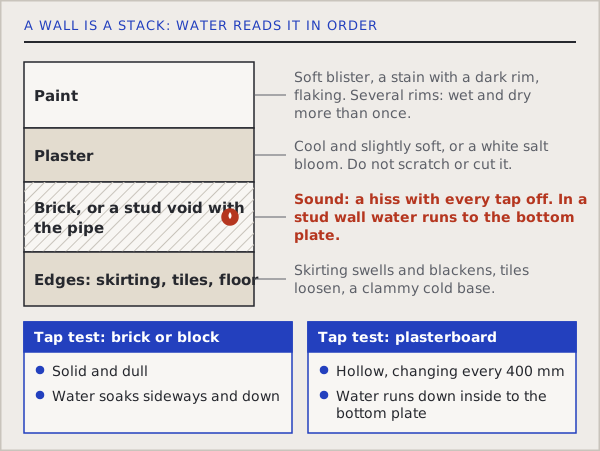
How to Tell if There Is a Leak in a Wall: Read the Layers
A leak in a wall shows through its layers, outermost first: paint blisters or stains, plaster goes soft, cold or dark, skirting and tile joints discolour, and…