On this page
A wall is a stack, and water reads it in order
Most London walls are one of two builds. An older solid brick or masonry wall is plastered directly onto the brickwork, often with a skim of newer plaster over an older base. A newer partition is plasterboard on a timber or metal frame, with the void between the boards. Pipes sit either chased into the brick behind the plaster or in the void of the frame.
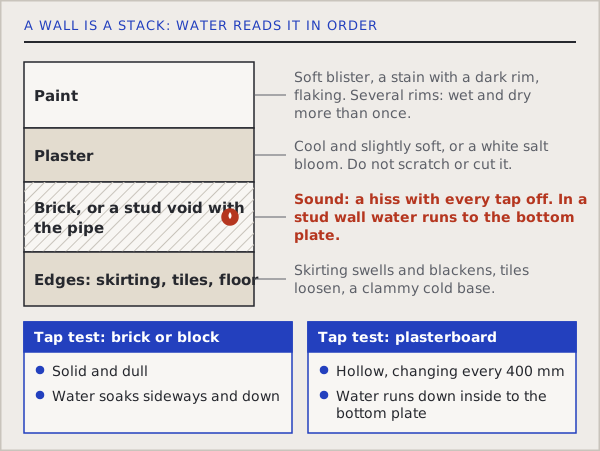
Water leaving a pipe meets whatever is next. In brick it soaks into the plaster and the brick, travelling sideways and downwards. In a stud wall it runs down the inside of the board and collects at the bottom plate, so the first sign is often at the skirting rather than at the pipe. Reading the wall means working out which build you have, then which layer is showing the signs.
Tap the wall. Brick or block sounds solid and dull. Plasterboard on a frame sounds hollow, and the sound changes every 400 millimetres or so where a stud sits behind. That one test tells you where water would travel.
Layer 1, the paint
Paint is the first witness. Water from inside shows as a blister that feels soft when pressed, a stain with a darker edge, or paint that lifts in flakes. Stains with a pale centre and a dark rim are tide marks: the rim is where the water dried at its widest. A tide mark that has several rims is a leak that has wetted and dried more than once.
The look-alikes are condensation, which forms in beads on a cold wall and runs down, and splash from a shower. If the mark is high on a wall with no tap or shower nearby, or tracks along a straight line at the height of a pipe run, water from inside is more likely. See the page on bubbling paint for the paint-only view.
Layer 2, the plaster
Press a thumb gently on the stained area. Plaster that is damp feels cool and slightly soft; plaster that is dry but old feels hard and slightly gritty. Wet plaster sometimes darkens a little under a thumbnail. Persistent damp may leave a white salty bloom as the water dries, which is a sign that moisture is passing through the wall, as the page on white powder on a wall explains.
Plaster that sounds hollow when tapped has lost its grip on the brick behind. That can be from moisture or from age, so the sound by itself is not a verdict. Yellow staining that appears and returns is covered in yellow stain on a wall, and cracks that run along a straight line are covered in cracks in plaster along a line.
Do not scratch, scrape or cut the plaster to look. It releases the water, spreads the damp and removes the evidence a survey would use to establish where the water began.
Layer 3, sound
Sound is the one sign that does not depend on a stain. Hold your ear, or the open end of a glass or cardboard tube, against the wall in a quiet house with every tap off. A pipe under pressure that is leaking produces a faint hiss. A flow with no tap running is more like trickling. Thumps and ticks as pipes warm and cool are movement, not leakage.
Compare the same spot with the stop tap on and then off. If the hiss stops when the water is turned off, it is a pressurised supply pipe. If it does not, it is either a heating pipe, which is under pressure in a different way, or a noise from somewhere else. The page on hissing in the wall goes further.
Layer 4, what sits at the edges
The edges of a wall carry water. Skirting boards swell and blacken at their lower edge, wall tiles loosen, and the floor next to the wall may lift. A cold wall that feels clammy at the base while the rest of the room is dry is a lead, and the page on swollen skirting lists the other causes. If the damp follows a vertical line from a bathroom above, it may be a waste or supply pipe coming down through the wall.
Ruling out what is not a pipe
Before assuming a pipe, look at what else puts water into a wall: a blocked or broken gutter, a cracked downpipe, a sealed gully, bridged damp-proof courses, and condensation on an external wall in cold weather. The gutters, gullies and damp walls note explains the exterior side. A wall that is wet only after rain, and dry after a few dry days, is usually external.
What a survey adds, and what it cannot do
Instruments read through plaster. Moisture mapping shows where the wall is wetter than the rest, thermal imaging shows cold or warm lines where a pipe runs, and acoustic detection listens for the leak itself on a pressurised pipe. None of them is a camera. A thick or insulated wall weakens the signal, and pin versus pinless moisture meters explains how deep each type reads, and a surface reading narrows the search without naming the joint. Whether a policy helps with the cost depends on its wording; does home insurance cover leak detection explains what to check.
Questions customers ask
Can you hear a leak inside a wall?
Sometimes. A leak on a pressurised pipe can hiss or trickle, and the sound is clearest in a quiet house at night with every tap off. A leak on a waste pipe makes no sound when nothing is draining. Hold your ear or a glass against the wall, then close the stop tap and listen again.
How do I tell damp from a pipe leak in a wall?
Damp from outside follows the weather and tends to be widespread. A pipe leak follows the pipe run, keeps growing when nobody is using water, and often changes when the stop tap is closed. A moisture reading and a dry-paper test help to separate them before anyone cuts the wall.
Should I drill a small hole to check?
No. A hole in the wrong place can hit a pipe or cable, release water and leave you no further forward. Read the layers first, paint, plaster, sound and the edges, then use instruments that read through the plaster. Cutting is the one step that cannot be undone.
Will a leak in a wall damage the electrics?
It can if water reaches sockets, switches or cables. If a wall is wet near electrics, turn off the water at the stop tap, switch off at the consumer unit only if you can reach it without standing in water, and keep clear of wet sockets and switches.
Related guides
 Leak guides
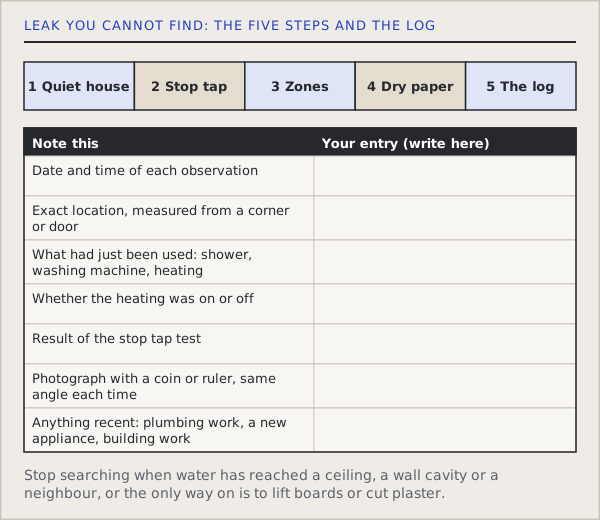
I Have a Water Leak but Can't Find It: A Self-Check With a Stopping Point
If you know water is escaping but cannot see it, work through five safe checks: confirm the leak is real, sort it into supply, waste or heating, isolate…
 Leak guides
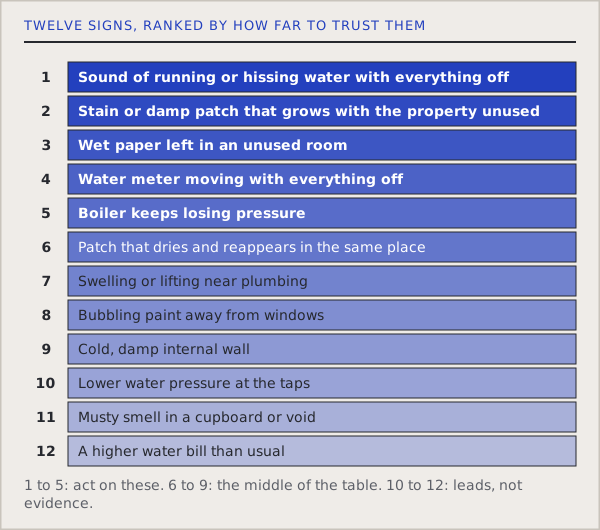
Signs of a Hidden Water Leak, Ranked by How Far You Can Trust Them
The most reliable signs of a hidden water leak are the ones that change while nobody is using water: a stain that grows, a sound that continues, a patch that…