On this page
If this result, then this
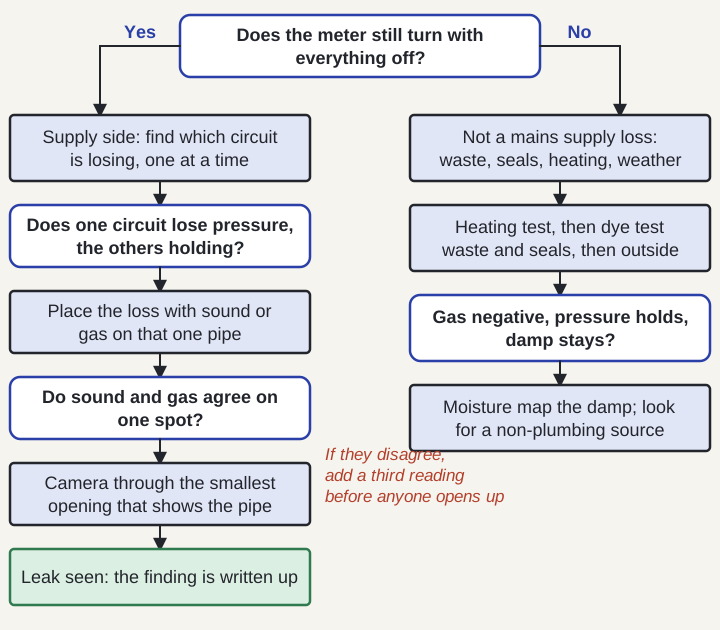
Read each row as a branch: the result on the left decides the next move on the right. The full ordered list of steps, with the price, is on the non-invasive leak detection page. This chart only covers what to do when a result arrives.
| Result | What it means | Next move |
|---|---|---|
| Meter turns with everything off | Water is being lost on the supply side | Find which circuit is losing, one at a time |
| Meter still, damp present | Not a mains supply loss; could be a waste pipe, a seal, heating or rain | Test the heating circuit, then run and dye test waste and seals, then check outside |
| One circuit loses pressure, others hold | The search is now one pipe | Place the loss with sound or gas on that pipe |
| No circuit loses pressure | The loss is intermittent or not under supply pressure | Repeat with the shower or appliance running, or look at waste and weather |
| Sound and gas agree on one spot | A strong position | Look at it with a camera through the smallest opening |
| Sound and gas disagree | One signal is being carried or masked | Add a third reading before anyone decides where to open |
| Gas negative, pressure holds, damp stays | Probably not the supply pipes | Moisture map the damp and look for a non-plumbing source |
| Camera shows a failed joint or pipe | The leak is located | The search ends and the finding is written up |
What you can safely do before anyone arrives
Check the water meter with all taps and appliances off, as in the meter spinning leak test. If the dial still moves, water is leaving somewhere. Know where your stop tap is. GOV.UK guidance says it is inside the home where the supply enters, or outside near the boundary under a cover, and that the position varies by property.
Write down when the problem started and what changes it, such as a tap running or the heating coming on. Photograph the stain. Do not open, drain or cut into a pipe, and leave gas and electrical parts to a qualified tradesperson. The leak source triage tool walks through the same questions. If nothing has stained, see a leak without visible stains.
Why the order matters
Each test answers one question. A pressure test says whether a circuit loses water, and nothing about where. A moisture meter says where a material is wet, and nothing about why. If the questions are asked out of order, the answers mislead. Where the pipe is hidden also changes which question comes first, which the guide to wall, floor and ceiling leaks sorts out.
A case on record shows how. On a two-visit job in WC1X, the first visit recorded a loss on the hot supply. The second visit pressure tested hot and cold twice and both held, and tracer gas was negative, so the camera went under the floor and the likely source moved to the shower area. The sequence kept the pipes from being blamed or opened on a hunch.
When the chart says stop
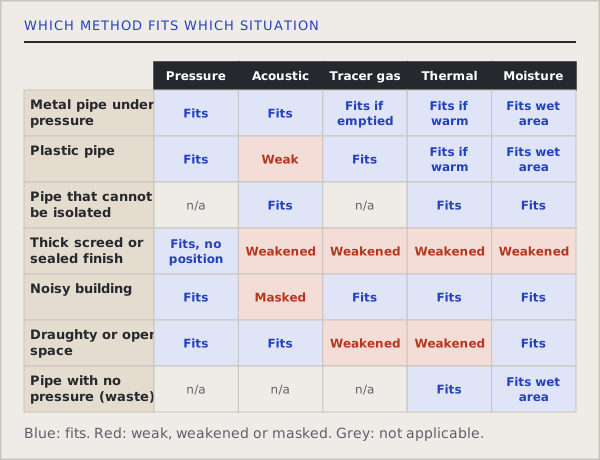
Some branches end with a limit rather than a leak. A pipe that cannot be isolated, a thick slab that holds gas below the surface, a leak that only runs when the shower is in use, or a neighbour's pipe are all places where the chart ends and the report says so. The non-invasive methods grid shows where each method stops.
See isolation testing step by step for how a circuit is cleared or kept in.
How a finished search is written down
A survey ends with one of three answers. A leak is located, and the report gives the circuit, the position and the readings behind it. A leak exists but is not located, and the report says which methods were tried, what each showed and what would be tried next. Or no leak exists, and the report records the tests that cleared the pipes.
The second answer is the honest one that many guides leave out. A hidden leak under a thick floor can outlast a visit, and the useful report is the one that narrows it, as the N10 washing machine case did with one leak found and a slower one still hidden.
Sources and dates
The stop tap position is from GOV.UK guidance on protecting a property from flooding, read October 2026. The WC1X case is our own record.
Questions customers ask
What is the first test for a hidden leak?
A check of the water meter with every tap and appliance off. If the dial moves, water is being lost on the supply side. The next test finds which circuit is losing, one at a time, before sound or gas is used to place the loss.
Can I find a leak in a pipe myself?
You can confirm that one exists with the meter and note where the damp is. Finding the position needs gauges, sensors or gas, and you should not open, drain or cut into pipes. Leave gas and electrical parts to a qualified tradesperson.
Why do pressure tests pass when I still have damp?
Waste pipes, seals and rainwater are not under supply pressure, so a pressure test can pass while they leak. That is why the second row of the chart looks beyond the supply pipes.
Where are the steps and the price set out?
On the non-invasive leak detection page, which gives the order of a survey and how it is charged. The package is £580 for a leak inside one property, and hourly rates apply if the source is outside it or no leak exists. No VAT is charged.
Related guides
 Methods
Non-Invasive Leak Detection Methods Compared: What Each One Senses and Where It Stops
Five non-invasive methods find hidden leaks without opening the structure: pressure testing, acoustic listening, tracer gas, thermal imaging and moisture…