On this page
The five methods in one grid
Read across a row to see one method. Read down a column to compare. The time column is relative to the other methods, because the real time depends on the building and is not promised here.
| Method | What it senses | Materials it suits | Time on site | Where it stops |
|---|---|---|---|---|
| Pressure testing | A fall in pressure on an isolated circuit | Any pipe that can be closed off and filled | Slowest per test, because the gauge is watched over a set period | Says a circuit loses water, not where |
| Acoustic listening | The sound of water escaping under pressure | Metal pipe best, plastic poorly | Quick per listening point, slower in noisy buildings | Silent on a pipe with no pressure or a very quiet leak |
| Tracer gas | Gas escaping from an isolated, gas-filled pipe | Most pipe that can be emptied, under many floor finishes | Moderate, depends on the area to sample | Weak under thick screed, sealed finishes or in draughts |
| Thermal imaging | Surface temperature patterns | Brick and plaster well, shiny metal and glass poorly | Quick to scan, slower to confirm | Sees the surface only and cannot see water |
| Moisture meters | Relative moisture in a material | Plaster, timber, screed, with care on masonry | Quick per point, slower as a grid | Cannot tell one source of damp from another |
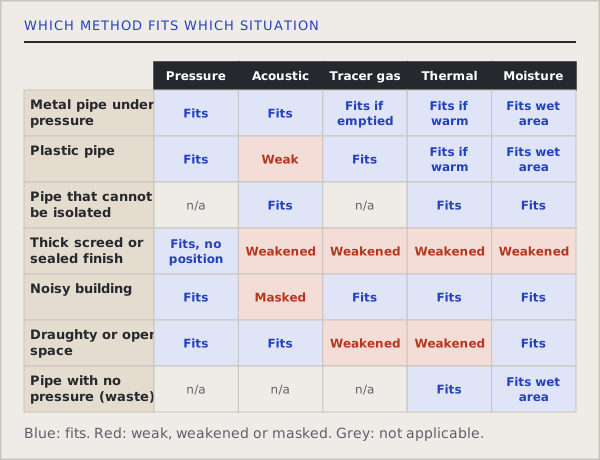
Which method suits which situation
The first grid compares the methods by what they sense. This one compares them by the situation on site, which is how a choice is narrowed in practice. Fits means a reasonable match, weakened or masked means the signal is reduced, and not applicable means the method cannot be used there. No row shows one method working alone.
| Situation | Pressure | Acoustic | Tracer gas | Thermal | Moisture |
|---|---|---|---|---|---|
| Metal pipe under pressure | Fits | Fits | Fits if it can be emptied | Fits if the pipe is warm | Fits for the wet area |
| Plastic pipe | Fits | Weak, setting dependent | Fits | Fits if the pipe is warm | Fits for the wet area |
| Pipe that cannot be isolated | Not applicable | Fits | Not applicable | Fits | Fits |
| Thick screed or sealed floor finish | Fits, no position | Weakened | Weakened | Weakened | Weakened |
| Noisy building | Fits | Masked | Fits | Fits | Fits |
| Draughty or open space | Fits | Fits | Weakened | Weakened | Fits |
| Pipe with no pressure (waste) | Not applicable | Not applicable | Not applicable | Fits | Fits for the wet area |
Acoustic and tracer gas: two ways of finding the position
Acoustic detection listens. Tracer gas smells, in effect. Sound is quick and needs no preparation but needs pressure and a pipe that carries sound. Gas needs the pipe isolated and filled but does not care about noise.
A published study of plastic water pipe by the Institute for Research in Construction in Canada, reported in June 2000, found that leak noise in plastic pipe is dominated by low frequencies and that correlators were often set too high to hear it. Acoustic work on plastic is therefore possible but depends on settings. Acoustic versus tracer gas sets out how a survey chooses between them.
The usual tracer mixture is 5% hydrogen in nitrogen. One industrial gas supplier describes it as non-toxic and not flammable, and warns it can asphyxiate in confined spaces, so the area is ventilated. See the tracer gas page.
Thermal imaging and moisture meters: two ways of reading the surface
Both read what has arrived at the surface and neither reads the pipe. The Carbon Trust, writing on thermography for traditional buildings, notes that brick and plaster give reliable thermal readings and that metals and glass reflect nearby temperatures, so they do not. It gives a working minimum of 5 degrees Celsius between inside and outside.
The Property Care Association guidance of July 2020 states that moisture meters cannot differentiate between dampness from one source and another. Used together the two methods are still useful: a cool patch on an image is measured with a meter, and a high meter reading is checked against a pressure test. See thermal imaging limits, moisture meter readings explained and pin versus pinless meters. A phone-sized thermal camera behaves differently from a survey camera, as this comparison shows.
What none of them can do
None of the five can see inside a wall. All of them infer from the surface or from a pipe that can be closed off. A leak that comes and goes may be gone when the survey arrives. A leak under a thick slab may be beyond every method on this page. A leak that is not plumbing, such as rain entering through brickwork, may show up as damp with every pipe clear. Which method leads depends on where the pipe is hidden, as choosing a method for a wall, floor or ceiling leak sets out.
When the five methods leave doubt, a camera through an existing access point is the next tool, covered in the endoscope guide. The order the methods are applied in, the price and the point where opening up is unavoidable are on the non-invasive leak detection page. Where the findings need to go to an insurer, the leak detection report for insurers page describes what the written report contains.
Sources and dates
Pressure, sound, gas, temperature and moisture behaviours above are checked against: the Plumbing and Mechanical magazine article on the Institute for Research in Construction plastic pipe study (June 2000); the Carbon Trust article on thermography for traditional buildings; the Property Care Association guidance document on moisture meters (July 2020); and a supplier product page for a 95% nitrogen, 5% hydrogen mixture (Formier 5). All were read in October 2026.
Questions customers ask
Which non-invasive method is the most accurate?
None is best alone. Pressure testing is the most direct check that water is being lost, and gas or sound gives the position. A survey uses several methods and checks one against another, so a position is only marked when the readings agree.
Is any of this harmful to the building?
Not in themselves. The methods work from the surface or from a pipe that is closed off. The tracer gas used is a 5% hydrogen in nitrogen mixture that a supplier describes as non-toxic and not flammable.
Can these methods find a leak under a concrete floor?
Sometimes. Gas and sound can both be weakened by a thick slab, and a pressure test only says a circuit loses water. The report says how far the search got.
Do I have to choose a method?
No. The methods are chosen on the day by what the leak and the floor allow. The package is £580 for one property whichever methods the leak needs. No VAT is charged. The order of a survey is on the non-invasive leak detection page.
Related guides
 Methods
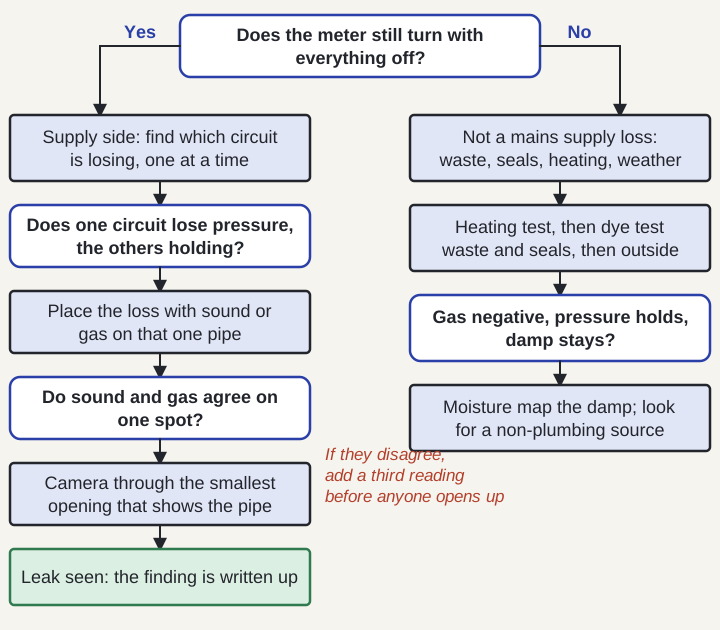
How Do You Find a Leak in a Pipe? The Order of Tests and What Triggers Each
A leak in a pipe is found by letting each test result choose the next move. A moving meter sends the search to the supply pipes, a still meter sends it…