On this page
Why a gas can find what water cannot show
Water that escapes from a hidden pipe soaks into plaster, screed or timber and travels, so the wet patch is rarely where the hole is. Gas behaves differently. Hydrogen is the lightest gas there is, so a mix containing it moves quickly through small gaps and rises, and the first place it reaches the surface is usually close to the breach.
The mix is the industrial blend explained at tracer gas, and its handling is covered in is tracer gas safe. What matters for the method is that, according to Pfeiffer Vacuum, a leak-testing equipment maker, the normal background level of hydrogen in air is as low as 0.5 ppm. That low background is the whole trick: a detector tuned to hydrogen sees almost nothing until the pipe is leaking. The trade name is forming gas, and why it is chosen over helium is in forming gas versus helium tracer.
The four steps of a tracer gas test
Every test follows the same order, whatever the pipe. The detail changes with the building, which is why the order matters more than the equipment.
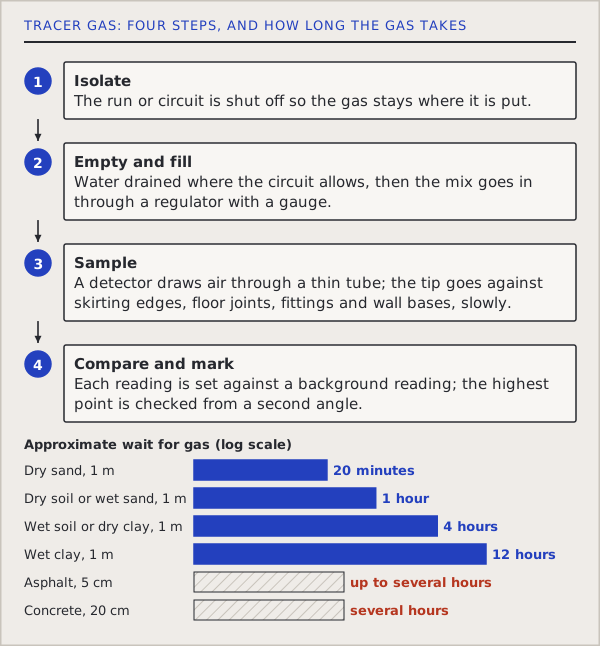
- Isolate. The pipe run or heating circuit under suspicion is shut off from the rest of the system so the gas stays where it is put.
- Empty and fill. Water is drained from the run where the circuit allows, then the mix goes in from a cylinder through a regulator with a gauge. Gas needs open pipe to travel along.
- Sample. A detector draws air through a thin tube and the tip is placed against skirting edges, floor joints, fittings and wall bases. Readings are taken slowly, because gas takes time to rise.
- Compare and mark. Each reading is set against a background reading from elsewhere in the room, and the highest point is checked again from a second angle before any opening is considered.
The test does not show a pipe is sound by itself. A pipe that holds gas and still loses water is not a gas problem, it is a different problem.
What the numbers mean
The detector shows parts per million of hydrogen. There is no universal reading that means leak, because the figure depends on the instrument, the room, the draught and how close the tip is. What carries meaning is the pattern: low and steady away from the pipe, then climbing as the tip nears the breach.
One job on record shows the pattern well. On a hydrogen heating manifold case the detector read 378 ppm and flagged HIGH at the manifold, 34 at a nearby fitting and 37 on the floor beside the sampling tube, both marked NORM. A leaking flow meter was seen at the high point. Those numbers belong to that detector on that day. The page on how readings are interpreted goes through them.
How long the gas takes to arrive
Gas does not appear at the surface at once. INFICON, a detector manufacturer, publishes an application note for locating water pipe leaks with hydrogen and gives approximate times for the gas to come up through different materials. The figures are for buried utility pipes, and they show the principle: the denser the cover, the longer the wait. How long a whole survey takes is a separate question, answered in how long a leak detection survey takes.
| Material over the pipe | Depth | Approximate wait for gas |
|---|---|---|
| Dry sand | 1 m | 20 minutes |
| Dry soil or wet sand | 1 m | 1 hour |
| Wet soil or dry clay | 1 m | 4 hours |
| Wet clay | 1 m | 12 hours |
| Asphalt | 5 cm | up to several hours |
| Concrete | 20 cm | several hours |
What the gas test cannot tell you
A reading says where gas is leaving, not why. It cannot tell a failed joint from a cracked pipe, and it does not say how much water is being lost. A pipe that leaks only while water is flowing through it, such as a waste, may hold gas perfectly well.
The same INFICON note says its detector pinpoints a leak to about one metre on a buried pipe, with samples taken about every 50 cm. Inside a home the cover is thinner but the pipework is denser, so a reading narrows the search to a zone, and a camera or a small opening confirms it. When tracer gas does not work lists the cases where the gas never reaches the detector.
The rig as it arrives on site describes what is carried through the door.
What tracer gas costs
Tracer gas work is £180 an hour, plus £80 for each gas cylinder used. No VAT is charged, and the rate is a fixed hourly rate that cannot rise on the day. The tracer gas service page has the full process, and the fixed price package is the one-property alternative.
Sources and dates
Checked in October 2026: Pfeiffer Vacuum, "What about Hydrogen? Part 1: Basics" (April 2024), for the 0.5 ppm background level; INFICON, application note "How to locate water leaks with the hydrogen method" (XRS9012 hydrogen leak detector), for the approximate surface times and the one-metre pinpointing. Readings quoted from the job records behind this site are not general thresholds.
Questions customers ask
Does tracer gas leak detection damage the floor or walls?
No. The gas goes into the pipe and a hand-held detector samples the air at the surface, so nothing is opened to find the leak. Any opening happens afterwards, and only if the reading and a second check agree on where. A high point is checked from a second angle first.
How long does the gas take to show a leak?
Anything from minutes under a thin floor finish to several hours under concrete. Utility testing figures from one detector maker run from 20 minutes through a metre of dry sand to several hours through 20 cm of concrete, so a dense cover means a long wait and readings are taken slowly.
Can tracer gas find a leak in a heating system?
Yes, when the circuit can be isolated and filled. The same 5% hydrogen mix is used, and a heating manifold job on record read 378 ppm at the leaking fitting against readings in the thirties nearby. A sealed circuit that cannot be isolated may need a different method.
Is the reading on the detector the size of the leak?
No. It shows how much hydrogen reached the probe, which depends on distance, draught and cover. It points to a place, not a flow rate, and it cannot say whether the cause is a failed joint or a cracked pipe. A second check confirms the position before any opening is considered.