On this page
Which part of the cycle does the puddle appear in?
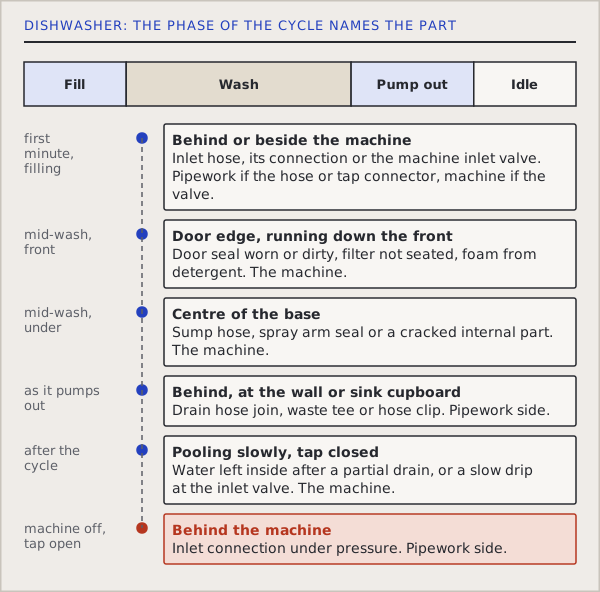
A dishwasher does three different things with water: it fills from the cold or hot supply, it sprays and recirculates inside, and it pumps out to the sink waste. Each uses a different set of parts, so each leaks in a different phase.
Put a sheet of dry cardboard or folded newspaper under the front and sides, run a short cycle, and look at the sheet at each stage rather than at the end. Note the time when the first spot appears.
| When water appears | Where it shows | Most likely source | Whose job |
|---|---|---|---|
| In the first minute of filling | Behind or beside the machine | Inlet hose, its connection, or the machine inlet valve | Pipework side if the hose or tap connector; appliance if the valve |
| Mid-wash, front of the machine | At the door edge, running down the front | Door seal worn or dirty, filter not seated, detergent causing foam | The machine |
| Mid-wash, directly under the machine | Centre of the base | Sump hose, spray arm seal or a cracked internal part | The machine |
| As it pumps out | Behind, at the wall or the sink cupboard | Drain hose join, waste tee, hose clip | Pipework side |
| After the cycle, with the tap closed | Pooling slowly | Water left inside from a partial drain, or a slow drip at the inlet valve | The machine |
| Even when the machine is off and the tap is open | Behind the machine | Inlet connection under pressure | Pipework side |
Quick checks that cost nothing
Check the filter in the base is clean and locked in, and that the door seal is free of food and sits flat. A dirty seal that lets water out at the front is the commonest bottom leak, and it is fixed with a cloth.
Check the detergent. Washing-up liquid or too much powder makes suds, and suds find the door seal. If you see foam at the door, run an empty rinse cycle and switch to dishwasher detergent only.
Check the machine is level. A machine that tilts forward lets water pool at the door edge, and a tilt left or right can make the door seal sit unevenly.
Is it the machine or the pipework?
The dishwasher has two connections to the house: a cold feed from a small valve, usually under the sink, and a drain hose to the sink waste. Anything between those two connections and the machine is pipework; anything inside the casing is the appliance.
Close the little feed valve and run the cycle again, putting a fresh dry sheet under the machine. If the puddle stops, the inlet side was leaking. If it still appears while the machine drains, check the sink cupboard: the drain hose joins the sink waste at a tee or a spigot, and that join is the usual pipework suspect. Dishwasher hose leaks behind the unit goes through that in more detail.
Do not pull the machine out while water is running or while the floor is wet. If the floor is wet around the machine and the plug, switch off at the consumer unit only if you can reach it without standing in water.
When the puddle is more than the machine holds
A dishwasher holds only a few litres at any time. If the puddle keeps growing after the cycle has ended, or you find wet on the floor or plinth when the machine has not run for hours, the source is a supply pipe, not the dishwasher.
A hidden connection behind a plinth, or a pipe run under the kitchen floor, will not show in a dishwasher test, and a dishwasher blamed for a leak is sometimes cleared, as in a case where the water came from under the bath. A kitchen leak survey separates the two with readings and a pressure check. A fault inside the machine is reported as such, and is for the maker or an appliance engineer. A leak that began with the first cycles after a new kitchen was fitted is covered in leak after a kitchen is fitted.
The fixed-price package is £580 to locate a leak in one property, with whichever methods it needs. No VAT is charged. No find, no fee applies when a live leak inside your own property cannot be located. A small repair, such as tightening a fitting or replacing a small part on the pipe, can be done on the same visit once the leak is found, agreed first, but not work inside the machine.
What a wet floor under a dishwasher can do
Water under a dishwasher rarely stays under it. It runs to the plinth, into the floor covering and under neighbouring units. Laminate and chipboard plinths swell, and a plinth that has swollen is a clue to where the water went; see kitchen plinth swollen or wet.
If the leak is old, the damp may be in the floor construction below the units, and a moisture reading across the floor edge shows how far it has gone. That reading is what tells you whether the dishwasher was the cause or only the place where an older leak surfaced. If the cupboard next to it smells damp with no visible wet, see under-sink cupboard smells damp.
What to note before you call anyone
A fault inside the machine goes to the maker or an appliance engineer. A leak on the pipe side goes to a leak survey if the source is not obvious. What decides it is the notes you take, so make them before the machine is moved.
Write down the model, the phase of the cycle when water first appears, where on the cardboard it lands, and whether the leak happens on every programme or only on the hot or the long ones. Hot programmes put more strain on seals and hoses, and a leak that only appears on the hottest wash suggests a seal or a hose that softens with heat.
Take a photo of the cardboard at the end of the test with a pencil mark at each wet edge. It is much easier to talk about a photograph than to describe a puddle.
Avoid running the machine repeatedly to prove the point. Each extra cycle puts more water into the units and the floor, and a wet chipboard base does not dry between tests.
Questions customers ask
Why is my dishwasher leaking from the bottom front?
Water running down the front usually leaves through the door seal, a filter that is not locked in, or foam from the wrong detergent. It is a machine fault or a use fault, not a pipe fault.
Can too much detergent make a dishwasher leak?
Yes. Too much detergent, or washing-up liquid used by mistake, makes suds, and suds are pushed out past the door seal and run down the front. Run an empty rinse cycle to clear the foam, then use dishwasher detergent only in the amount the maker gives.
Is a leaking dishwasher dangerous?
It can be. Water near the plug and the machine wiring is dangerous, so keep clear of wet sockets and switch off at the consumer unit only if you can reach it without standing in water. A slow leak on a dry floor is less urgent but still damages the units and the floor under them.
How do I tell a dishwasher leak from a sink leak?
Run the sink alone with the dishwasher off, then run the dishwasher alone, with a dry tissue wrapped round the waste tee in the cupboard. The test that wets the tissue shows which one is leaking. If the tissue stays dry in both, the source is elsewhere in the cupboard or the floor.
Related guides
 Leak guides
Kitchen Floor Wet Near the Sink With No Obvious Leak
A kitchen floor that is wet near the sink with no obvious leak is usually splash, condensation, a slow drip or a hidden pipe. A two-day log separates them: dry…