On this page
Four things that wet a kitchen floor
Before looking for a leak, rule out the ordinary causes. Each leaves a different pattern, and the log in the next section is built to tell them apart.
- Splash and drips from washing up, wet cloths and a dripping dish rack, which stop when you stop
- Condensation on a cold pipe or a cold floor tile, which forms in cold weather or after cooking and dries by midday
- A slow drip from the tap, the waste or an appliance connection, which wets after use and dries slowly
- A hidden pipe or heating leak, which keeps the area wet when nothing is being used
The 48-hour log
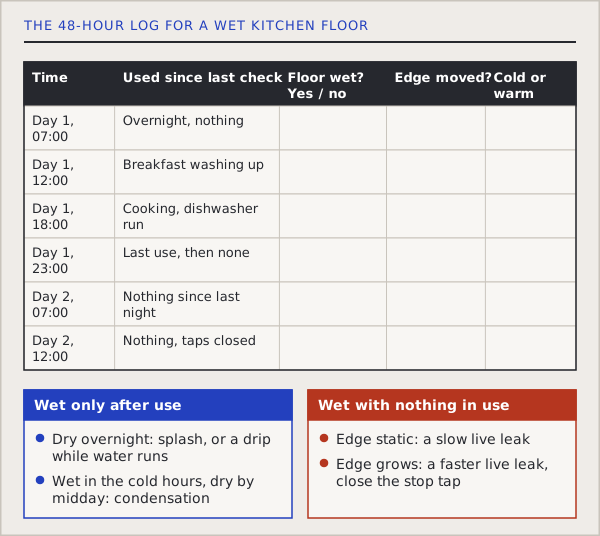
Dry the floor properly with a towel and mark the edge of the damp area with a strip of masking tape or a pencil line. Then record what you see at fixed times for two days. A phone note works; the table shows the columns to keep.
On day one, use the kitchen as normal and write down each use of the sink and appliances. On day two, from the evening, use no water in the kitchen at all, including the dishwasher and washing machine, and keep checking the edge. The overnight rows are the most useful ones.
| Time | Water used since last check | Is the floor wet? | Has the wet edge moved? | Floor and room temperature |
|---|---|---|---|---|
| Day 1, 07:00 | Overnight, nothing | Yes or no | Edge marked | Cold or warm |
| Day 1, 12:00 | Breakfast washing up | Yes or no | Beyond or inside the mark | Cold or warm |
| Day 1, 18:00 | Cooking, dishwasher run | Yes or no | Beyond or inside the mark | Cold or warm |
| Day 1, 23:00 | Last use, then none | Yes or no | Beyond or inside the mark | Cold or warm |
| Day 2, 07:00 | Nothing since last night | Yes or no | Beyond or inside the mark | Cold or warm |
| Day 2, 12:00 | Nothing, taps closed | Yes or no | Beyond or inside the mark | Cold or warm |
How to read the log
If the floor is dry on every overnight check and wets only after use, the cause is splash or a slow drip at a fitting that leaks while it is wet. If it is wet only at the cold hours and dry by lunch, suspect condensation, and check whether the wet is on a cold-water pipe or against an outside wall. See a cold pipe sweating or leaking.
If the floor is wet at every overnight check, with no use, there is a live source. Cold supply, hot supply, heating pipe and a waste that is full of standing water are all possible. If the wet edge also grows, the leak is not slow.
| What the log shows | Most likely cause | Next step |
|---|---|---|
| Wet only after use, dry overnight | Splash, or a drip while water runs | Tissue trace under the sink, see leak under kitchen sink |
| Wet in the cold hours, dry by midday | Condensation | Look at pipe lagging and ventilation |
| Wet overnight with nothing used, edge static | A slow live leak | Isolate sections of supply and watch the meter |
| Wet overnight and the edge grows | A faster live leak | Close the stop tap and call |
Checks that need no tools
Read your water meter, if you have one, last thing at night and first thing in the morning with every tap closed. A reading that moves means water is leaving the supply. A meter that stays still on the supply side points to waste, condensation or a heating circuit.
Look at the central heating pressure gauge on the boiler. If it keeps dropping and you have to top it up, a heating pipe is a candidate for a wet floor even when the cold taps are off. Heating leaks are a separate problem from drinking-water leaks and are surveyed at a different rate.
If water is running near electrics or a pipe is flooding the property, turn off the water at the stop tap and keep clear of wet sockets.
When the log says it is a pipe
A wet floor with no use points to a pipe in the floor or behind the units. At that point you can stop guessing and take readings. A moisture meter across the floor edge shows where the wettest area is, and a pressure test shows which branch is losing water; pin versus pinless moisture meters shows what each type of meter reads through a floor covering.
Bring the log; the times of the wet checks save time on the day. Read the kitchen leak survey page to see how the visit runs. A kitchen that was fitted recently has its own checks, set out in leak after a kitchen is fitted.
The fixed-price package is £580 to locate a leak in one property, with whichever methods it needs. No VAT is charged. No find, no fee applies when a live leak inside your own property cannot be located. A small repair, such as tightening a fitting or replacing a small part on the pipe, can be done on the same visit once the leak is found, agreed first. A larger repair is quoted before any work starts, and the leak is stopped in the meantime; see repair after detection. Damage to cupboards and finishes is quoted separately through a partner team, as set out in leak damage repair. Whether a policy covers that damage depends on its wording; an escape of water insurance claim, step by step lists what to keep.
Why the wet patch is rarely where the leak is
Kitchen floors are built in layers: a floor covering, often an underlay or a board, then screed or timber below. Water that gets in at the sink does not stay put. It runs to the lowest point or the nearest joint, travels under the covering and then rises at an edge, a seam or the door threshold.
On a timber floor, water follows the joists and can surface a metre or more away, or drip through the ceiling of the room below. On a concrete floor it spreads sideways under the covering and lifts the edge. A tiled floor may show water first at the grout line furthest from the leak, because that is where the water has found the weakest seal.
This is why the log asks where the wet edge moves, not just whether it is wet. An edge that creeps outward along one side is following something. An edge that stays put and dries is a surface problem. A floor that stays wet with no stain anywhere is covered in leak without visible stains.
Questions customers ask
Can a kitchen floor be wet from condensation alone?
Yes, on a cold tile floor or under a cold pipe, especially after cooking or washing up in cold weather. Condensation dries during the day and returns in the cold hours, and the wet sits on a cold surface or beneath a cold pipe. A floor that is wet overnight with nothing used is not condensation.
The floor is wet but the cupboard under the sink is dry. Where is it coming from?
The source could be the dishwasher, a pipe in the floor, an appliance behind a plinth or a neighbour. The 48-hour log tells you whether water use is needed for the floor to wet, and a moisture reading along the floor edge shows the wettest point to follow.
Does laminate or vinyl hide a kitchen leak?
It can. Water travels under the covering and appears at a seam, a skirting board or a door threshold, away from the source. The wettest reading on the floor is where it has pooled, not where it started.
Should I keep drying the floor?
Yes, until the source is located, and mark the wet edge each time so the log stays accurate. Water left to soak into the floor build-up spreads the damage to the units, plinths and floor covering, and a wet chipboard base does not dry on its own.
Related guides
 Leak guides
Dishwasher Leaking From the Bottom: Read the Timing
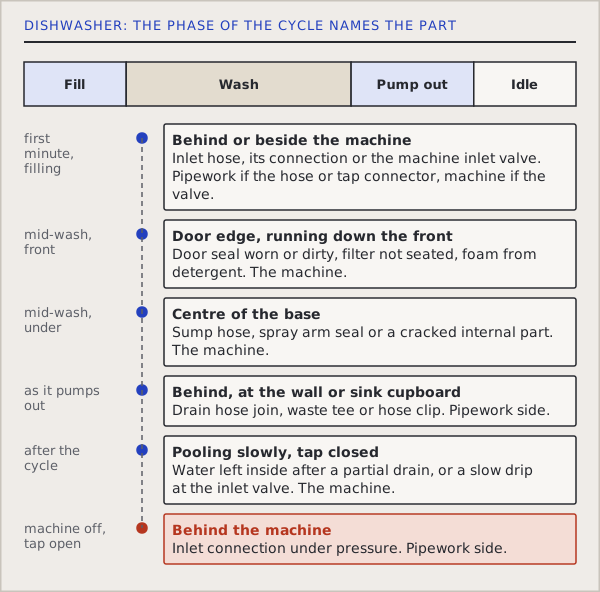
A dishwasher leaking from the bottom is machine, inlet pipework or waste pipework, and the timing separates them. Water at the start of a cycle points to…