On this page
What you need and how the three tools work
The kit is deliberately plain. A torch with a strong beam, held low and almost flat along a surface, shows damp shadows and weeping joints that overhead light hides. A dry tissue or a sheet of kitchen roll shows moisture by touch: pressed against a joint, it darkens at once if there is any water. A thermometer, preferably an infrared one that reads surface temperature, shows cold spots. Evaporating water cools a surface, and a leaking cold pipe holds it cold, so a patch several degrees below the wall around it is worth following up.
Take a notebook as well. Write the room and the reading each time, because the point of the walk is comparison: this wall against the other wall, this morning against this evening. Start the walk when the property has been quiet for an hour or more, so that any water you meet has been leaking, not splashing.
Order of the walk, by likelihood
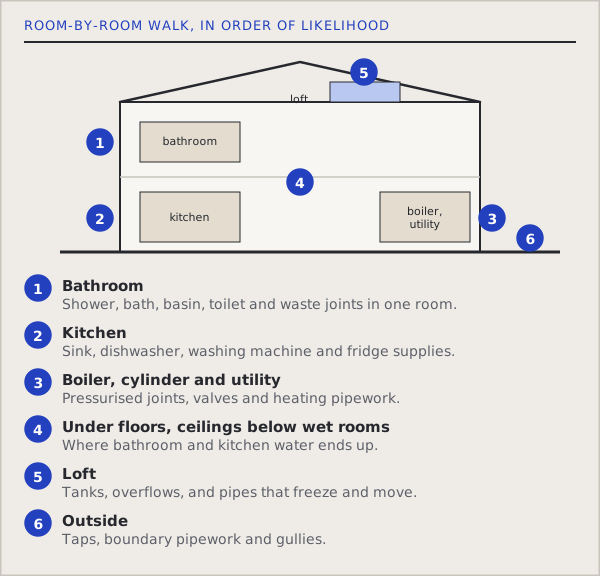
Leaks cluster where there are the most joints, the most movement and the most hot water. Walking in that order saves time.
| Order | Place | Why it comes at this position |
|---|---|---|
| 1 | Bathroom | Shower, bath, basin, toilet and waste joints all in one room |
| 2 | Kitchen | Sink, dishwasher, washing machine and fridge supplies |
| 3 | Boiler, cylinder and utility | Pressurised joints, valves and heating pipework |
| 4 | Under floors and ceilings below wet rooms | Where bathroom and kitchen water ends up |
| 5 | Loft | Tanks, overflows and pipes that freeze and move |
| 6 | Outside | Taps, boundary pipework and gullies |
Bathroom and kitchen: what to look at
In the bathroom, shine the torch along the base of the toilet, the tap tails under each basin, the underside of the bath through the panel or access hatch if one exists, and the edge of the shower tray. Press tissue against each compression joint and each push-fit connector. Check whether the sealant is intact and whether the floor next to the bath feels soft or the covering has lifted. The more detailed room guides are leak under the bath and shower tray leaking.
In the kitchen, empty the cupboard under the sink and put the torch on the back wall and the underside of the worktop. Look for water marks on the base of the cabinet, tide lines on the back, and swelling of chipboard. Pull the washing machine and dishwasher forward only if they are on isolating valves and you can do it without straining hoses; otherwise look behind with the torch. Hoses weep at the connection to the tap and at the back of the machine. The dishwasher hose guide covers that corner.
Give each joint about ten seconds of tissue contact. A joint that is wet only after the tissue has been there is a slow weep. It still counts.
Boiler, heating and utility areas
Around the boiler look for drips, white or green crust on fittings, and wet insulation. Look at the radiator valves and the pipes below radiators. A heating leak often leaves a ring of corrosion or a stain at a valve. A boiler whose pressure falls repeatedly, so that it needs topping up, is losing water from the heating circuit somewhere, which is a different survey from a mains leak. Do not open the boiler casing, release pressure or drain any part of the system. Heating faults involving gas are for a qualified tradesperson.
Ceilings, floors and walls
Look up at the ceilings below every wet room and under the kitchen. Look for yellow-brown rings, bubbling paint and sagging. Look down along the skirting and the threshold of each wet room for swelling, lifted floor coverings and cold patches underfoot. Use the thermometer on a wall or floor you suspect and then on one that you do not, in the same conditions, and write both down.
A wall that is cold and slightly damp to the touch compared with the wall next to it is worth marking. The wall-wet-or-cold-to-touch guide explains the other causes, because cold external walls with condensation behave in a very similar way.
Loft and outside
In the loft, only go where there is safe boarding and good light. Look at the cold water tank, its overflow pipe and the pipework around it. A stain on the underside of the roof boards or on insulation below a pipe can mean a slow drip. If the tank overflow is dripping outside, the float valve is probably passing water; the loft tank overflow guide explains what that shows.
Outside, look at the outside tap and the wall around it, the ground along the line that the supply pipe takes from the boundary, and gullies for staining or constant flow. A patch of unusually green or soft ground in dry weather can mean a buried pipe leaking, though a few reasons can sit behind it. See wet patch in the garden. Where the supply pipe comes into the house, damp where the water pipe enters the house lists three causes to tell apart.
What the walk cannot detect
This walk finds visible leaks and leaks with visible effects. It does not find a joint inside a wall, a pipe in a screed, a supply pipe buried in the ground, or a waste that leaks only when a bath empties. For these, the practical choice is between more searching and instrumented detection. The first usually means breaking things. To catch the next leak early, water leak sensors and where to place them goes room by room.
A survey chooses methods from what the walk found. Acoustic detection listens for the sound water makes escaping under pressure, thermal imaging shows cold or warm paths, and moisture mapping shows where a material is wetter than its neighbours. Before you book, does home insurance cover leak detection explains which policy wording to check.
Questions customers ask
What is the easiest way to detect a water leak at home?
Turn off every tap and appliance, listen in a quiet house, then press dry tissue against the joints under sinks, behind toilets and at appliance hoses. Wet tissue shows a leak your eyes miss. Then check the water meter: if it moves with everything off, water is escaping somewhere in your own pipework.
Can a thermometer find a leak?
It can show a cold patch worth investigating, because evaporating water cools a surface and a leaking cold pipe holds it cold. It cannot tell a leak from condensation or a cold bridge, so a cold reading is a lead, not a diagnosis. Compare it with a reading on a wall you do not suspect.
Where do most leaks in a house start?
Most start where there are joints and movement: the bathroom and kitchen, appliance connections and pipework around the boiler. That is why the walk goes there first, then to the floors and ceilings below wet rooms, the loft and outside.
Is it safe to look in the loft for a leak?
Only where there is safe boarding and good light, and never by stepping on plasterboard between joists. If the loft is not boarded, look from the hatch with a torch and leave the rest to a professional. A stain under a pipe or tank is worth noting from there.
What if the walk finds a drip I can see?
Turn the water off at the stop tap if it is more than a drip, put a container under it and keep the area dry. A visible drip can still hide a second leak behind it, so ask for the surrounding pipework to be checked and keep a photograph of where it started.
Related guides
 Leak guides
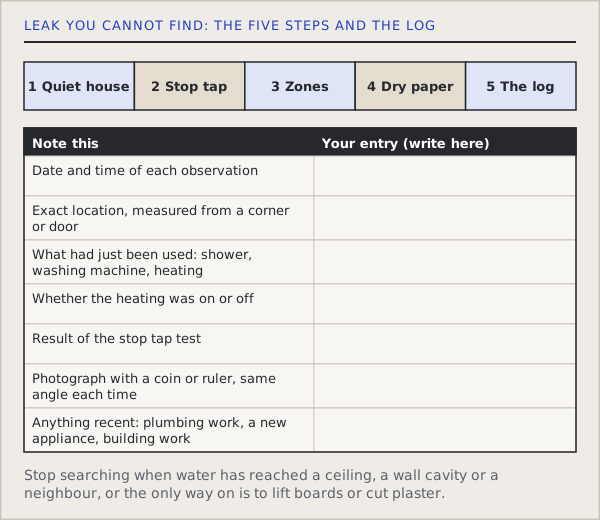
I Have a Water Leak but Can't Find It: A Self-Check With a Stopping Point
If you know water is escaping but cannot see it, work through five safe checks: confirm the leak is real, sort it into supply, waste or heating, isolate…
 Leak guides
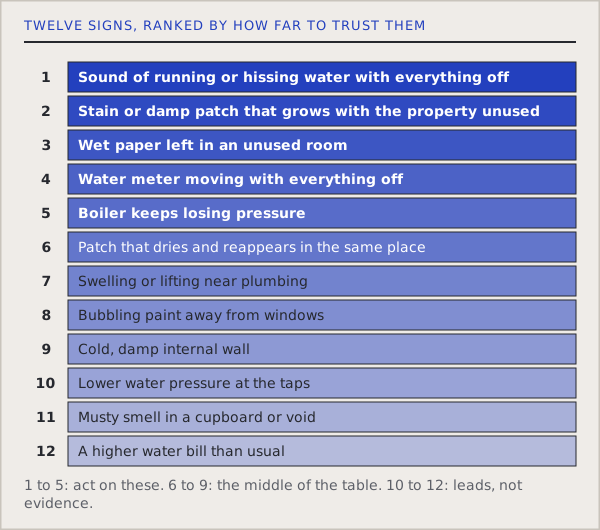
Signs of a Hidden Water Leak, Ranked by How Far You Can Trust Them
The most reliable signs of a hidden water leak are the ones that change while nobody is using water: a stain that grows, a sound that continues, a patch that…