On this page
How to read a ranking of signs
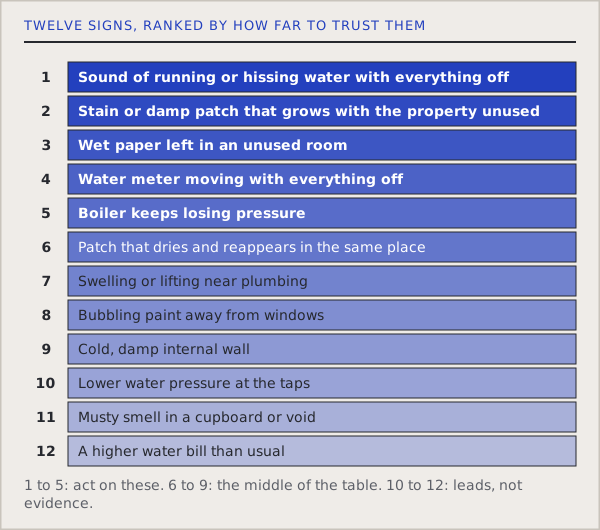
A sign is reliable when it is hard to explain without a leak. Condensation, a spilled drink and an old stain can all produce a mark on a ceiling, so a mark by itself ranks low. Water moving through a pipe in a house where every tap is off has one explanation, so sound with the house quiet ranks high.
Three tests decide a sign's rank. Does it change with nobody using water? Does it grow or repeat over days? Can it be reproduced by turning one thing off, such as the stop tap? A sign that passes all three is strong. A sign that passes none is a reason to look, not a reason to cut a wall open.
Twelve signs in order of reliability
The table orders the signs from the one that most often means a leak to the one that least often does. The third column is the harmless thing that most often imitates it.
| Rank | Sign | Most common false positive |
|---|---|---|
| 1 | Sound of running or hissing water with every tap and appliance off | A cistern refilling after a slow fill, or a water softener cycling |
| 2 | A stain or damp patch that grows with the property unused | A drying stain that looks larger as the edge shows |
| 3 | Water on dry-paper test paper left in an unused room | Condensation on a cold surface |
| 4 | Water meter moving with every tap and appliance off | An appliance you forgot, such as an automatic cistern, softener or outside tap, a sticking float valve, or a faulty meter |
| 5 | A boiler that keeps losing pressure and needing top-up | A failed expansion vessel or a pressure relief discharge |
| 6 | A patch that dries and reappears in the same place | Weather entering through a roof or wall |
| 7 | Swelling or lifting of skirting, flooring or cabinet bases near plumbing | Humid air or a past leak that has since stopped |
| 8 | Bubbling or peeling paint away from windows | Condensation or a poor paint job on a damp-prone wall |
| 9 | A cold, damp wall surface on an internal wall | A cold bridge on a wall that backs onto an outside wall |
| 10 | Lower water pressure at the taps | Work on the local network, or a blocked filter |
| 11 | A musty smell in a cupboard or floor void | Poor ventilation and old damp |
| 12 | A higher water bill than usual | More people at home, a seasonal garden, or a billing estimate |
The top five: when to act
If you have sign 1, 2 or 3, treat it as a leak until shown otherwise. Turn off the water at the stop tap if the sound or the patch is serious, and keep clear of wet sockets. These are the signs that a leak survey can usually follow to a pipe.
Sign 4 is the meter test, and it is the easiest of the strong signs to run yourself. Turn off every tap and appliance, then watch the meter: if it keeps moving, water is passing downstream of it, which is your own pipe, including the supply pipe running to the house. A leak on the water company's side of the meter cannot register on it. Rule out the forgotten appliance first, such as an automatic cistern, a softener or an outside tap. A meter that sits still is reassuring but does not clear every leak, because a very small loss can take hours to show.
Sign 5 is a different circuit. A heating system loses water through a leak or through a failing component, and either way it needs looking at. Do not release pressure or drain anything yourself.
Sound deserves a short note. Pipes that tick, bang or whistle as they heat or cool are not leaking. Constant hissing or trickling when the house is quiet is the one to take seriously. The hissing sound in the wall page separates the two.
Signs 6 to 9: the middle of the table
These signs are real evidence but not proof. A cold internal wall that is damp only in cold weather may simply be below the dew point of the room air. The commonest trap is the patch that comes and goes, because people assume it only happens when it is wet outside. Check by timing: a patch that returns on dry days after a quiet night is a leak with a pattern, and the leak that comes and goes guide explains how to catch it.
Swelling and peeling are the aftermath of water, not the source. They tell you that moisture has been present for some time, not where it came from. A swollen kitchen plinth next to a dishwasher, for instance, is a lead toward the dishwasher hose, not a certainty. Check the guide to swollen skirting boards for what else causes them.
Signs 10 to 12: leads, not evidence
A bill, pressure and a smell are what people notice first, and they are the weakest. A bill reflects billing periods, estimates and household changes. A smell reflects air and ventilation. Pressure reflects the street, so a drop that affects the whole road is a matter for the water company. A hose-tap gauge reading, as in how to measure water pressure at home, tells you more than a feeling that the shower is weaker.
Use these three to decide whether to look further. Never use them to decide where the leak is. A high bill plus a growing stain is a leak. A high bill alone is a reason to take a meter reading, not to open a floor. How much water a pinhole leak wastes shows what a small hole can lose.
What no list of signs can do
Signs say that water is present. They do not name the pipe, the joint or the depth. A leak survey exists for that step, using instruments to read through surfaces without opening them first. How accurate leak detection is shows what a survey can and cannot name, and water leak sensors and where to place them helps catch the next leak early. A single high bill is weak evidence on its own, and high water bill from a hidden leak shows how to check it.
Sometimes the survey establishes that the signs came from condensation, a roof, a gutter or an old, dry stain. If water has already damaged the property, what to do after a water leak at home lists the steps in order.
Questions customers ask
What is the first sign of a hidden water leak?
Most often it is the sound of running or hissing water in a quiet house, or a stain that keeps growing with nothing in use. A higher bill is usually noticed later and is the weakest sign, so look first for anything that changes while nobody is using water.
Can a hidden leak exist without any smell?
Yes. A clean water leak can run for a long time without any smell. A musty smell appears only when materials stay wet for long enough to start to decay, so its absence says little about whether a leak is present.
Does a high water bill mean I have a hidden leak?
Not by itself. Check for changes in the household, estimated bills and seasonal use, then watch the water meter with every tap and appliance off. If it moves, water is passing through your own pipework, which is a much stronger sign than the bill.
Is mould a sign of a hidden leak?
Sometimes, but condensation and poor ventilation are more common causes. Mould that is local to a plumbing wall, a floor edge or the ceiling below a bathroom is more suspicious than mould in a cold corner. Treat it as a lead and look for a stronger sign alongside it.
How long can a water leak go unnoticed?
Months, if it is slow and sits inside a floor void, a wall or the ground. Clean water gives no smell, and a stain may take a long time to reach a visible surface. A meter that moves with every tap off is the quickest check that something is escaping.
Which sign means I should call straight away?
Water near electrics, active flooding, a ceiling that is sagging with water, or a patch that grows overnight. Turn off the water at the stop tap, keep clear of wet sockets, and switch off at the consumer unit only if you can reach it without standing in water.
Related guides
 Leak guides
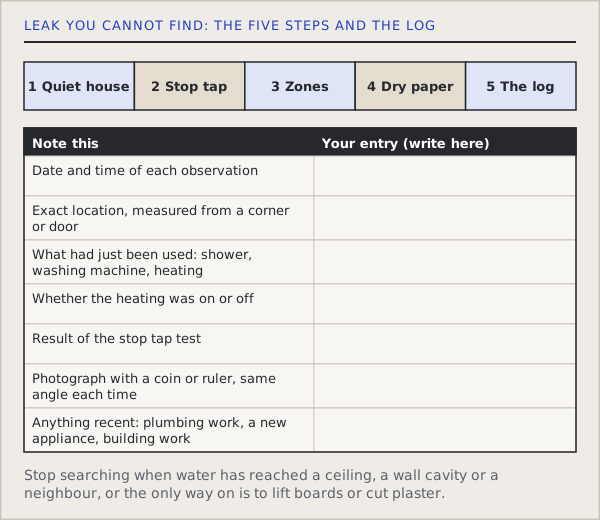
I Have a Water Leak but Can't Find It: A Self-Check With a Stopping Point
If you know water is escaping but cannot see it, work through five safe checks: confirm the leak is real, sort it into supply, waste or heating, isolate…
 Leak guides
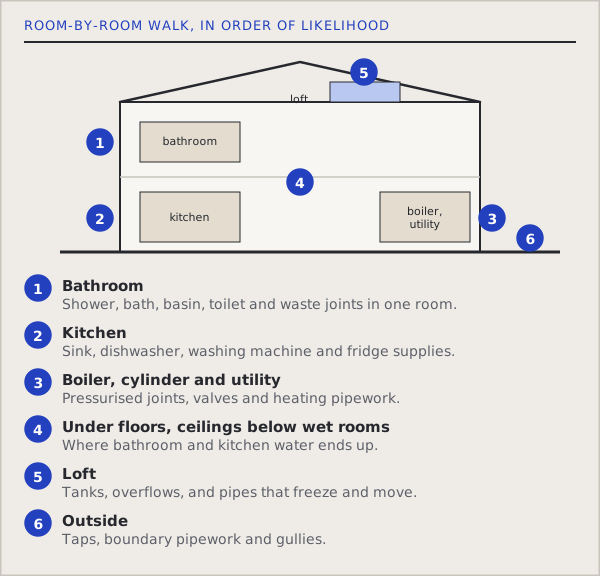
How to Detect a Water Leak in Your House: A Room-by-Room Walk
To detect a water leak in your house, walk it room by room with a torch, a dry tissue and a cheap thermometer, starting where leaks are most likely: bathroom…