On this page
First, is there definitely a leak?
People often start the search on a hunch: a bill that looks high, a smell, a patch of paint that has lifted. Before you go looking, collect the evidence that water is genuinely going somewhere it should not. A search without evidence ends with holes in a wall and no leak behind them.
Strong evidence is something that changes while nobody is using water. A stain that grows overnight, a meter that moves with every tap shut, the sound of running water in a quiet house, a wet patch that is wetter on Friday than it was on Tuesday. Weak evidence is a single reading, a single stain that has never changed, or a smell on its own. Smells are the weakest of all, because damp has many causes and not all of them are plumbing.
If your evidence is weak, treat the next day as an observation period. Do not open anything, do not seal anything, and do not repaint the stain. A stain you have painted over cannot be measured against itself.
The five-step self-check
These steps are in order of effort and risk. Each one only involves looking, listening, touching and turning an ordinary tap off. None of them involves opening a pipe, a boiler, a cylinder or anything electrical.
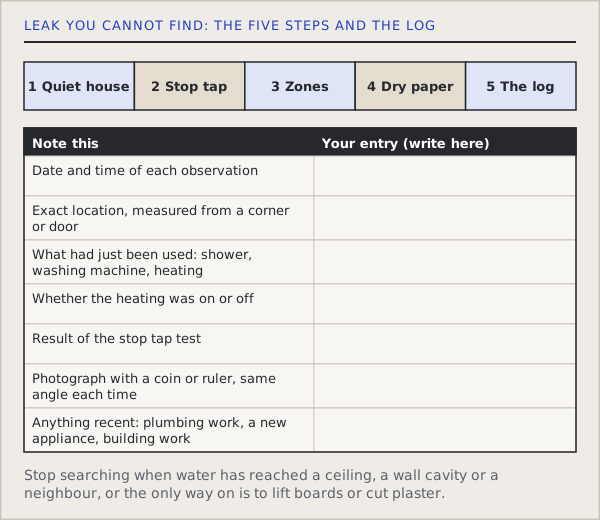
- Step 1, quiet house. Switch off every tap and appliance that uses water, then stand still in the quietest room for two minutes. Listen at the skirting, at the cupboard under the stairs and at the boiler cupboard. A hiss, trickle or tick that continues is a supply or heating leak under pressure.
- Step 2, the stop tap. Close the main stop tap, usually under the kitchen sink or where the supply enters the house. If a sound stops or a stain stops growing within the hour, the water was coming from the cold mains supply. If nothing changes, the source is more likely a waste pipe, heating system, tank or something outside the supply.
- Step 3, zones. Open the stop tap again. Check each wet room in turn: bathroom, kitchen, utility, then outside taps. Look under the sink, behind the toilet cistern, at the bath panel edge and at the washing machine hoses with a torch.
- Step 4, the dry-paper test. Lay a sheet of kitchen roll on or against the damp surface, mark its position with a pencil, and check it after an hour and again the next morning. Wet paper in an unused room is the most reliable thing a householder can produce.
- Step 5, the log. Write down what you saw, with times. The next section says what.
What to write down
A written record is the most useful thing you can hand to a surveyor. It saves time on site, and it tells the person testing which pipes to isolate first. Copy the table below onto paper, or photograph the page, and fill one line each time you check.
| Note this | Why it matters |
|---|---|
| Date and time of each observation | Shows whether the leak is constant or follows a pattern |
| Exact location, measured from a corner or door | Water rarely appears above its source; a fixed reference helps the survey start well |
| What had just been used: shower, washing machine, heating | Links the leak to one appliance or one circuit |
| Whether the heating was on or off | A leak that appears only with the heating on points to the heating circuit |
| Result of the stop tap test | Separates mains supply from everything else |
| Photograph with a coin or ruler for scale, same angle each time | Proves growth or shrinkage |
| Anything recent: plumbing work, a new appliance, building work | Often explains where to look |
Where leaks hide when they cannot be seen
Most pipes in a London home are out of sight. They run in chases behind plaster, under floorboards, in screed under tiles, between floors and inside boxing. A leak in any of these shows up somewhere else: where the water first meets something porous or something that lets it drop.
That is why the wet patch and the leak are two different places. Water follows a pipe, a joist or a slab edge before it surfaces. The page on where leaking water travels shows the usual routes. A ceiling stain in the room below a bathroom, for example, may sit a metre or more to one side of the fitting that is leaking.
The less obvious hiding places are the ones people miss: the underside of a bath, the back of a kitchen plinth, the void behind a radiator pipe, the join where a waste meets the soil stack, and the pipe that runs to an outside tap. If you have a short, safe look at each of these with a torch and still see nothing, the leak is probably inside a surface.
The point at which to stop searching
Stop when any of these is true. It is not a failure to stop; it is the point at which the next step costs more than the information is worth.
- The stop tap test changed the picture but you cannot see any visible pipe in the area
- Evidence of water has reached a ceiling, a wall cavity, a floor covering or a neighbour's property
- You have run the dry-paper test twice and paper is wet in an unused room
- The only way to go further is to lift boards, cut plaster or take off tiles
- The heating pressure keeps falling or a boiler keeps needing to be topped up
What a survey does that you cannot
A survey does not start by cutting. It uses instruments that read through surfaces: acoustic detection listens to pressurised pipes, tracer gas follows a non-flammable, non-toxic gas (one that can displace air, so it is used with ventilation) out of a pipe that has been isolated, thermal imaging shows temperature differences at the surface, and moisture meters map where a material is wetter than it should be. Which are used depends on what your observations suggest, which is why the log matters. Eight questions to ask before hiring a leak detection company helps you compare firms. No find, no fee applies when a live leak inside your own property cannot be located; the terms are on the no find, no fee page.
What this self-check cannot tell you
It cannot name the pipe. It cannot tell a pinhole from a failed joint, or a leak you are paying to lose from one that is merely soaking into a wall. A negative result on every step does not prove there is no leak either, because a very slow weep can pass all of them. It does give a surveyor a head start, and it keeps you from damaging a wall to look for something that is somewhere else. The step that settles the supply side is the meter leak test, and does home insurance cover leak detection explains why cover for a search depends on the policy and the insurer decides.
Questions customers ask
How do I find a hidden water leak in my house?
Confirm it with the stop tap test and the dry-paper test, listen in a quiet house, check the visible pipework in each wet room with a torch, and keep a log. If that does not place it, instruments such as acoustic detection and tracer gas can, without opening the structure first.
Should I cut into the wall to look?
Not as a first step. Water travels along pipes and joists before it surfaces, so the wall at the stain is the least likely place to find the leak. Cutting in the wrong place causes damage and still leaves the source undiscovered; use the stop tap test and a survey first.
Can a leak exist if there is no stain?
Yes. A leak can soak into a floor void, a screed or the ground, and a bill, a sound or a heating gauge may be the only signs. See leaks without visible stains for the clue table and what each can mean.
Is a hidden leak an emergency?
It is urgent if water is near electrics or flooding: turn off the water at the stop tap and keep clear of wet sockets. Otherwise it is time-sensitive, because a slow leak damages the structure for as long as it runs, so book a survey rather than waiting for a stain.
Who do I call first if the leak is in a flat?
Tell the managing agent or landlord, and tell the neighbours below. Water crosses boundaries between flats, and the log you have kept is the evidence everyone will need to agree where the water began. Photograph each check, keep the times, and avoid cutting anything open before the source is known.
Related guides
 Leak guides
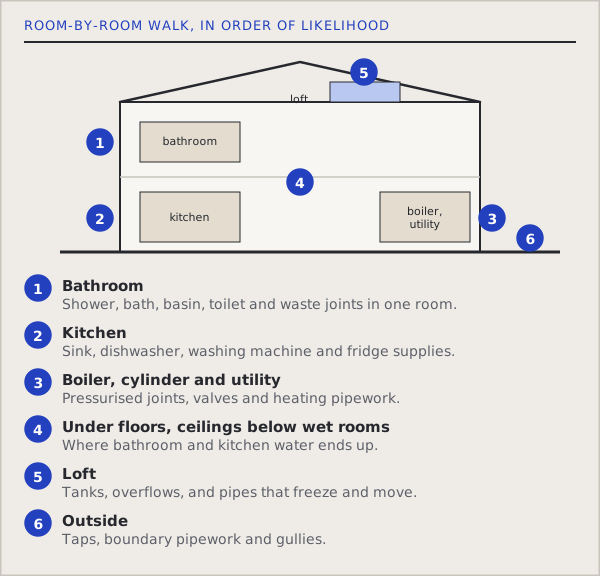
How to Detect a Water Leak in Your House: A Room-by-Room Walk
To detect a water leak in your house, walk it room by room with a torch, a dry tissue and a cheap thermometer, starting where leaks are most likely: bathroom…
 Leak guides
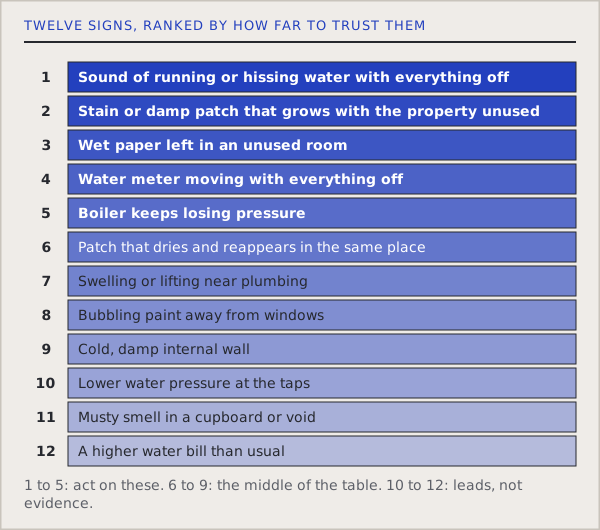
Signs of a Hidden Water Leak, Ranked by How Far You Can Trust Them
The most reliable signs of a hidden water leak are the ones that change while nobody is using water: a stain that grows, a sound that continues, a patch that…