On this page
What is pressure testing, and what happens during a test?
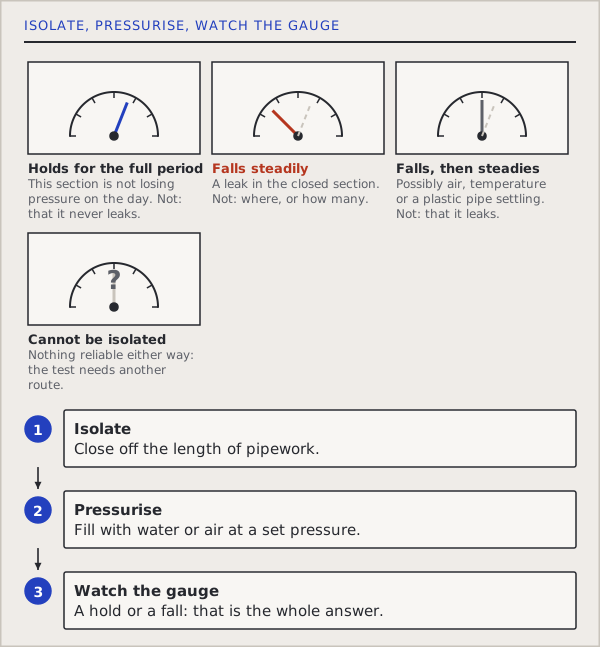
Pressure testing of pipes means holding a closed section at a set pressure and watching whether it drops. Used to find leaks, it answers one question: is this section losing water? It is the first step of leak detection, before any method that narrows down the position.
Pipework only shows a leak under pressure if it is first closed off. The first step is isolating the section: shutting the stop tap or a valve, and closing every outlet on that section so water has nowhere to go but out of a fault. A gauge is then fitted at a convenient point, often an outside tap, a draw-off or a manifold, and the pipework is brought up to the pressure being tested.
The gauge is watched for a set period with nothing drawing water. A needle that stays where it was put means the closed section is tight. A needle that creeps down means pressure is escaping from somewhere inside it. What a pressure gauge tells you goes through the reading itself, and isolation testing step by step covers how a house is cut into sections. Pressure gauges from the field puts a holding reading and a falling one side by side.
What does a falling needle tell you?
It tells you that something in the closed section is losing pressure. It does not give a position. A joint in a wall, a corroded length under a floor, a pinhole in a copper pipe, a valve passing water and a connector at an appliance can all pull the needle down in the same way.
That is why the test is paired with a second method. On a home with warped hallway floorboards in N16, a pressure test on the supply showed that water was being lost, and an access panel at the bath then led to a corroded 15 mm cold supply pipe behind the toilet pan connector. The gauge decided that the pipes were the problem. The panel found the place.
Why the test is not a commissioning test
Water companies publish pressure testing methods, but those are for new pipework. Essex and Suffolk Water guidance on the Water Supply (Water Fittings) Regulations 1999 says that new water systems must be tested hydraulically before commissioning, and sets out example methods. For rigid pipework the pressure is raised to a test pressure chosen by the designer and held for at least an hour, and a loss of no more than 20 kPa after that hour counts as a pass. For plastic pipe the method differs, because plastic stretches under pressure and settles afterwards, so the same guidance describes a staged test with a relaxation period and a check that the pressure curve rises as the pipe contracts.
A leak-finding pressure check on an old house has a different job. It does not certify the pipework to a standard. It asks a narrower question: does this closed section hold or not? The difference matters because plastic pipe settles under pressure, so a short test on a plastic system can show a slow fall that is not a leak. The gauge has to be read with the pipe material in mind. United Utilities guidance makes the same point: a one-hour 10 bar test is a rigid-pipe test and is not accepted for polyethylene pipe.
When the test cannot give a clear answer
A pressure test is only as good as the isolation. If a section cannot be fully closed, the gauge cannot tell you whose water is leaving. In a cellar in W3, in a building where the flats above shared one mains, not every outlet could be shut, so the gauge could not give a clear result. The search moved outside and found a blocked gully overflowing against the wall. The damp was water from outside, not a pipe.
Other things can hide a leak or imitate one: a tap or float valve that passes slowly, a heating system that is open to a header tank, a hot water vessel that expands when it warms, trapped air that compresses, a fall in temperature that lowers the pressure. A leak on the waste side is not under supply pressure at all, so the test passes while the ceiling below stays wet. Hot and cold pressure tests compared shows what each side can and cannot reveal.
What a pressure test does and does not rule out
These are the usual outcomes and what each one allows you to say. The same hold is how a repair is checked later, as in how to check a leak repair has worked.
| Gauge result | What you can say | What you cannot say |
|---|---|---|
| Holds for the full period | This closed section is not losing pressure on the day | That it never leaks; a leak that only opens when a tap or washing machine is used can sit beside a clean test |
| Falls steadily | There is a leak in the closed section | Where it is, or how many there are |
| Falls, then steadies | Possibly air, temperature or a plastic pipe settling | That the pipework is leaking |
| Cannot be isolated | Nothing reliable | Either way; the test needs another route |
What you should and should not do yourself
Do not pressurise anything yourself. Pipework, valves and gauges rated for a test are part of the equipment, and over-pressure can split a joint that was weeping into one that is flooding. Reading the pressure at a tap is a different, simpler check, set out in how to measure water pressure at home. If you suspect the supply is losing water, the check you can safely make is to find your stop tap, which Thames Water says is commonly under the kitchen sink and sometimes in an airing cupboard, under the stairs or near the front door, and to know how to close it by turning it clockwise.
If water is running near electrics, or a pipe is actively flooding, the safety lines on this site apply first. The test is for a calm, planned visit, not an emergency.
What it costs
A pressure test takes time in proportion to the number of branches, because each one is isolated, pressurised and watched. A house where the supply splits many ways needs more watching than one with a single run, and on an hourly visit that watching is the time charged. The page on what is included lists the scope. On the £580 fixed price package, known before the visit, the test is one of whichever methods the leak needs. No VAT is charged. No find, no fee applies when a live leak inside your own property cannot be located.
Sources and dates
The new-pipework test methods (the one-hour hold, the 20 kPa limit for rigid pipe, the staged test for plastic pipe) are from Essex and Suffolk Water guidance note 3 on pressure testing of new water supply pipework. The point on polyethylene pipe and the one-hour 10 bar test is from the United Utilities hydrostatic pressure testing leaflet. The stop tap locations are from the Thames Water page on finding and using the inside stop valve. All read in October 2026. The N16 and W3 cases are from the job records behind this site.
Questions customers ask
Can a pressure test find the exact spot of a leak?
No. A pressure test shows that a closed section of pipework is losing pressure, not where the loss is. A joint in a wall, a corroded length under a floor and a passing valve all pull the needle down in the same way. A second method, such as tracer gas, acoustic detection or an endoscope, then finds the position.
What is a leak pressure test?
It is a pressure test used to find out whether a closed section of pipework is losing water. The section is isolated, brought to a set pressure and watched on a gauge. A falling needle means a leak exists in that section. It does not give a position, so another method does that.
Does a passed pressure test mean there is no leak?
It means the closed section held for the period watched, on that day. A waste pipe is not under supply pressure, so the test passes while a ceiling below stays wet, and a leak that opens only when an appliance runs can sit beside a clean result. The search then moves to waste, seals, overflows or outside water, and a survey can end without a leak being located, as why a survey sometimes finds no leak explains.
Will a pressure test damage my pipes?
It should not when it is done by a competent person at a suitable pressure with equipment rated for the job. That is also why householders should not try it, because over-pressure can split a joint that was weeping into one that is flooding. The check you can safely make is finding and closing your stop tap.
How long does the gauge have to be watched?
Long enough for a slow fall to show. Published water company methods for new rigid pipework hold the test pressure for at least an hour, and plastic pipe needs a staged test because it stretches and then settles. Those are commissioning tests, not leak-finding thresholds, so older and plastic systems can need longer to read properly.
Related guides
 Methods
How Does Tracer Gas Leak Detection Work? Gas In, Detector Over the Surface
Tracer gas leak detection fills an isolated pipe or sealed circuit with a lean hydrogen and nitrogen mix. The gas escapes wherever the pipe is breached, rises…